
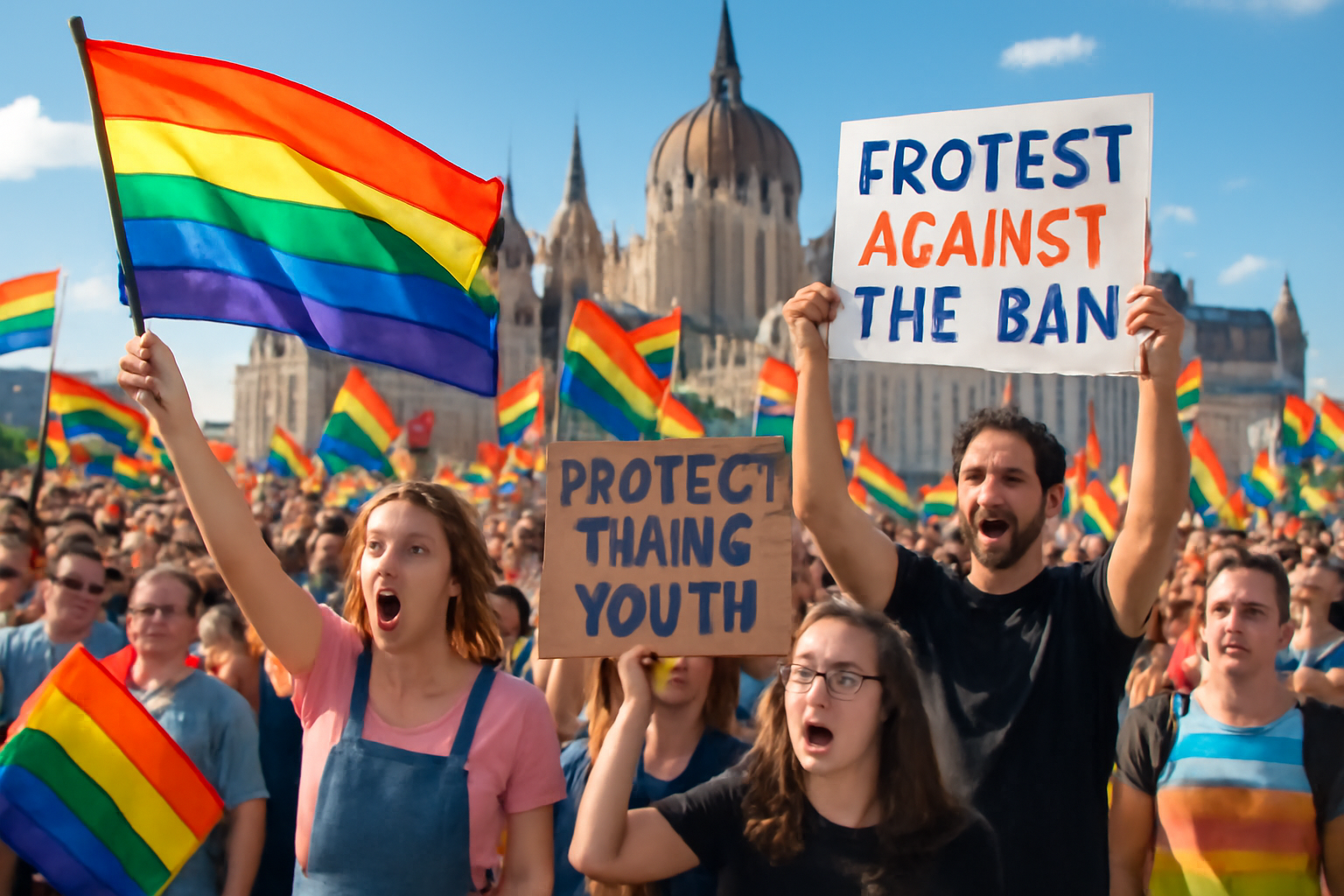
In a shocking move, the Hungarian Parliament has passed a controversial law that bans Pride events across the nation and permits the use of facial recognition software to track attendees. The law, supported by Prime Minister Viktor Orbán’s Fidesz party and the Christian Democrats, was passed with a 136-27 vote. It has drawn widespread condemnation from both domestic and international communities.
Protests and Outrage in Budapest
Following the law's passage, thousands of protestors took to the streets of Budapest, the capital of Hungary, to express their discontent. The protestors demonstrated outside the Parliament building, while opposition lawmakers inside set off rainbow-colored smoke bombs to voice their dissent.
Later, protestors blocked key thoroughfares, including the iconic Erzsebet Bridge over the Danube River, demanding the government retract the law. The police ordered the protestors to disperse, but the crowd remained defiant, highlighting the growing tension between the ruling party and those advocating for LGBTQ+ rights.
Echoes of Russia’s Policies
Evgeny Belyakov, a Russian expatriate living in Hungary, expressed his concerns about the new law, drawing parallels with similar oppressive measures in Russia. “It’s quite terrifying to be honest, because we had the same in Russia. It was building up step by step, and I feel like this is what is going on here,” Belyakov remarked. He hopes for more resistance in Hungary, emphasizing the need to act before it’s too late.
Legal and Social Implications
The new law stipulates a fine of approximately $550 for attending or organizing events that may feature "depiction or promotion" of homosexuality, especially where minors might be present. This legislation is an extension of Hungary's 2021 "child protection" law, which restricts exposure to LGBTQ+ topics in schools and media.
This legislative move has sparked a global debate about human rights and the protection of LGBTQ+ individuals within Hungary. The European Union, of which Hungary is a member, has already challenged the country’s previous laws on the grounds of discrimination based on sexual orientation and gender identity.
International Reactions
Budapest Pride organizers released a statement condemning the law, stating, “This is not child protection, this is fascism.” The organizers and other LGBTQ+ advocates argue that the law further marginalizes the community and restricts fundamental freedoms.
Various international leaders and human rights organizations have denounced Hungary’s decision, calling for increased protection of minority rights. The European Union has previously taken legal action against Hungary for similar laws, and this recent development is likely to escalate tensions between Hungary and the EU.
Despite the overwhelming opposition, the Hungarian government maintains that the law is necessary to protect children from content it deems inappropriate. However, critics argue that such legislation undermines democracy and freedoms that are the bedrock of the European Union.
Call to Action
The passage of this law has mobilized activists and allies worldwide to rally in support of Hungarian LGBTQ+ communities. Many are calling for immediate action, urging the international community to apply pressure on the Hungarian government to revoke the law.
As protests continue in Budapest and beyond, the Hungarian LGBTQ+ community remains steadfast in their fight for rights and recognition. The international community watches closely, hoping for a resolution that upholds human rights and equality for all.
Stay informed about global LGBTQ+ issues by subscribing to our newsletter. Receive the latest updates directly to your inbox and join the conversation about equality and justice.
The situation in Hungary is a poignant reminder of the ongoing struggle for LGBTQ+ rights around the world. As these events unfold, it is crucial to continue advocating for inclusivity, understanding, and acceptance in every corner of the globe.
Related Posts
Supreme Court to Address State Bans on Trans Women in Female Sports
The upcoming U.S. Supreme Court term promises to be a pivotal moment for transgender rights, as the nation's highest court has agreed to evaluate whether states have the authority to prohibit transgender women from participating in female sports competitions. This case, scheduled to be argued in the next term beginning October, is expected to have a significant impact on the future of sports inclu [...]
Megan Rapinoe and Sue Bird Announce Amicable Separation After Ten Years Together
In a heartfelt announcement that resonated deeply within the sports and LGBTQ+ communities, soccer star Megan Rapinoe and basketball legend Sue Bird have revealed their decision to part ways after nearly a decade together. The couple, who have been icons both on and off the field, shared the news with their fans through a joint statement on social media, expressing that the choice was made with mu [...]
Groundbreaking Ruling Ends Sodomy Ban for Police and Military in the Dominican Republic
The Constitutional Court of the Dominican Republic recently delivered a landmark decision on November 18th, ruling that the nation’s police and armed forces are not permitted to criminalize consensual same-sex relations among their personnel. This pivotal ruling is a significant stride towards equality and the protection of LGBTQ+ rights within these institutions. A Resounding Victory for Equal [...]