
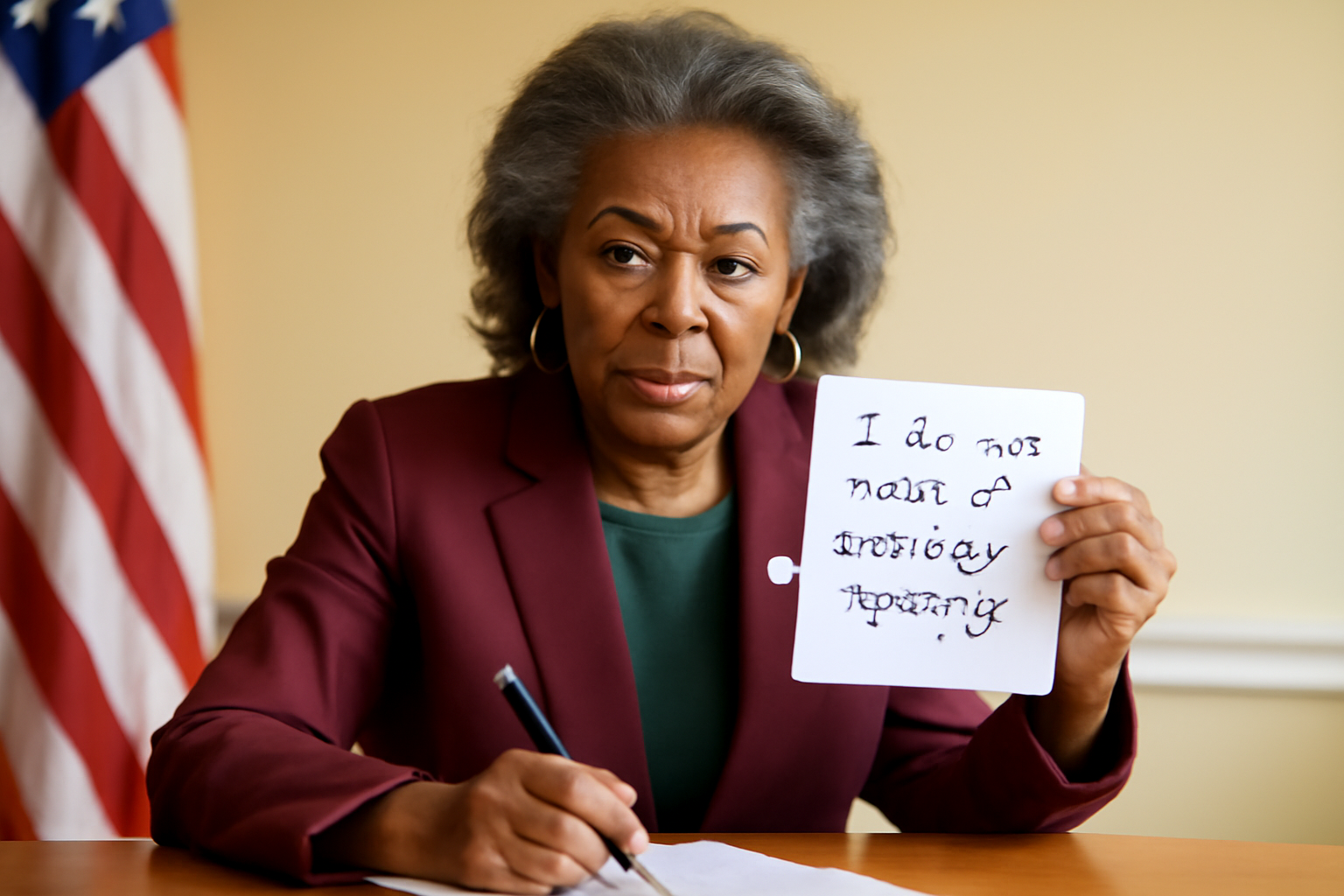
Virginia’s current Lieutenant Governor, Winsome Earle-Sears, has once again found herself at the center of a political stir following revelations about her handwritten note opposing marriage rights for same-sex couples. This comes after her official signing of a bill that sought to affirm marriage equality within the state, in line with her constitutional responsibilities. The controversy has highlighted ongoing tensions within Virginia's political landscape, particularly around LGBTQ+ rights.
Divergent Views on Marriage Rights
Last year, a handwritten note by Earle-Sears surfaced, revealing her personal opposition to House Bill 174. The bill, introduced by state Delegate Rozia Henson, an openly gay Democrat representing Prince William County, sought to embed marriage equality firmly within the state’s legal framework. Despite her personal views, Earle-Sears' constitutional role necessitated her signing the bill as the President of the Senate, a technical position she holds by virtue of her office.
This bill passed the Virginia Senate with a 22-17 vote, marking a significant legislative step for LGBTQ+ rights supporters in the state. Subsequently, Governor Glenn Youngkin, a Republican who received bipartisan support for this legislation, signed it into law. Yet, Earle-Sears' note underlined a persistent ideological divide, stating, "As the lieutenant governor, I recognize and respect my constitutional obligation to adhere to procedures set out in the constitution of Virginia. However, I remain morally opposed to the content of HB 174 as passed by the General Assembly."
Historical Context and Political Implications
Earle-Sears, who made history as the first woman to become Virginia's lieutenant governor, has a political track record that includes service in the Virginia House of Delegates from 2002 to 2004. Her journey in politics has been marked by a series of controversies, particularly around her stance on LGBTQ+ issues. Her opposition to marriage equality reflects a broader conservative ideology that she has maintained throughout her career.
Previously, Earle-Sears faced backlash when she misgendered State Senator Danica Roem, a transgender woman, during a session on the Senate floor. This incident drew sharp criticism from LGBTQ+ activists who viewed it as emblematic of Earle-Sears' contentious approach to gender and sexuality issues. Further complicating her political narrative is her participation in the Conservative Political Action Conference, a platform known for its conservative viewpoints.
Future Political Aspirations
Looking ahead, Earle-Sears is gearing up for a gubernatorial run to succeed Governor Youngkin when his term concludes in January 2026. Her anticipated opponent in this race is expected to be former U.S. Representative Abigail Spanberger, a Democrat with a history of representing Virginia’s 7th Congressional District. This upcoming election is likely to be closely watched, with LGBTQ+ rights poised to be a central issue.
In related political maneuvers, John Reid, an openly gay conservative talk show host, has secured the Republican nomination to potentially succeed Earle-Sears as lieutenant governor. This development, however, has not been without drama. Governor Youngkin recently urged Reid to withdraw from the race amid allegations involving the sharing of explicit content on social media, accusations Reid has vehemently denied.
The unfolding political scenario in Virginia highlights the complex intersection of personal beliefs and public duty, especially in the realm of civil rights and equality. As these discussions continue, the state remains a microcosm of the broader national debate over LGBTQ+ rights and the role of personal convictions in legislative actions.
As Virginia moves forward, the resolution of these issues will be crucial in shaping the political and social landscape, impacting not only those directly involved but also the wider community seeking equality and representation in the state’s legislative processes.
Related Posts
Supreme Court to Address State Bans on Trans Women in Female Sports
The upcoming U.S. Supreme Court term promises to be a pivotal moment for transgender rights, as the nation's highest court has agreed to evaluate whether states have the authority to prohibit transgender women from participating in female sports competitions. This case, scheduled to be argued in the next term beginning October, is expected to have a significant impact on the future of sports inclu [...]
Megan Rapinoe and Sue Bird Announce Amicable Separation After Ten Years Together
In a heartfelt announcement that resonated deeply within the sports and LGBTQ+ communities, soccer star Megan Rapinoe and basketball legend Sue Bird have revealed their decision to part ways after nearly a decade together. The couple, who have been icons both on and off the field, shared the news with their fans through a joint statement on social media, expressing that the choice was made with mu [...]
Groundbreaking Ruling Ends Sodomy Ban for Police and Military in the Dominican Republic
The Constitutional Court of the Dominican Republic recently delivered a landmark decision on November 18th, ruling that the nation’s police and armed forces are not permitted to criminalize consensual same-sex relations among their personnel. This pivotal ruling is a significant stride towards equality and the protection of LGBTQ+ rights within these institutions. A Resounding Victory for Equal [...]