
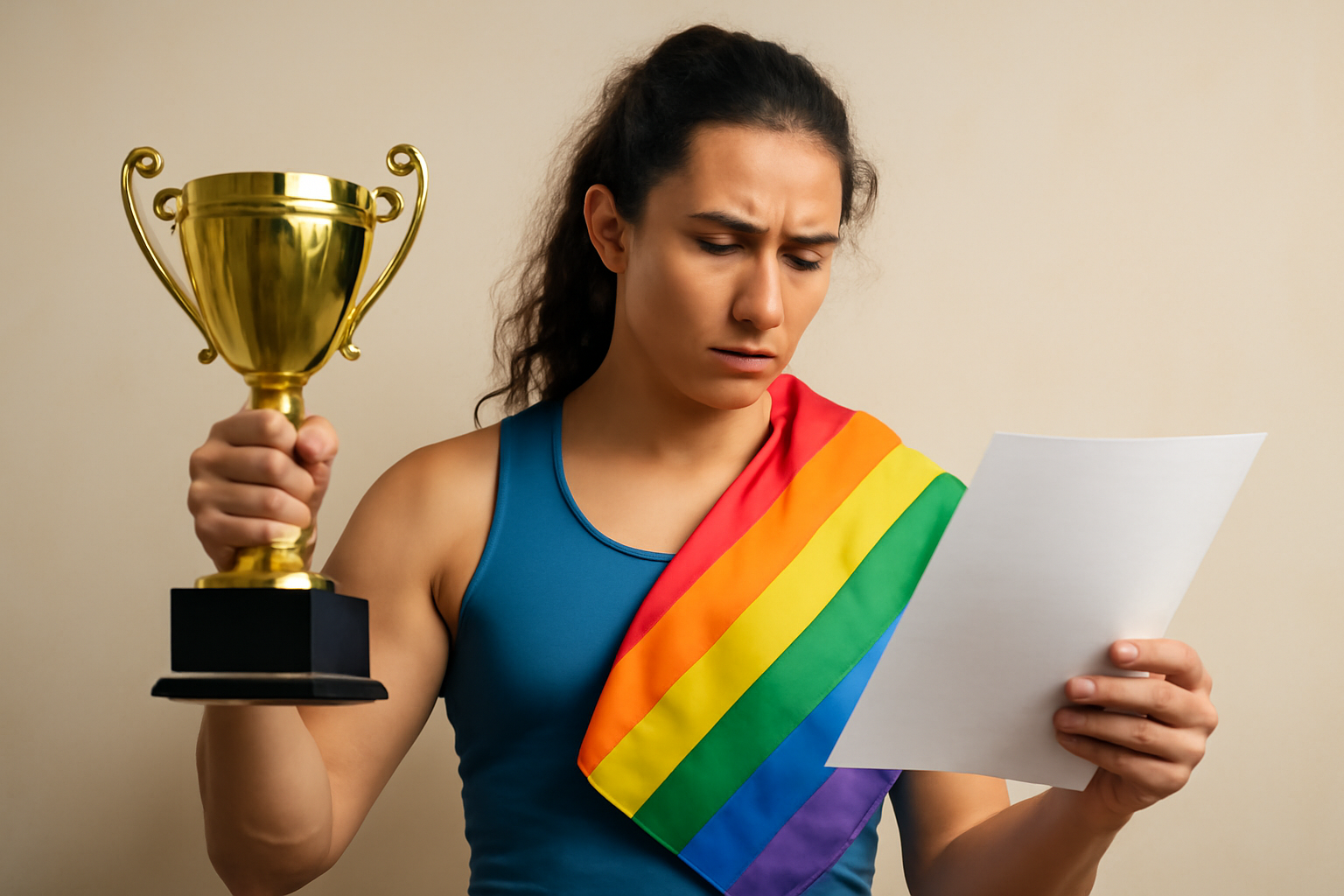
In recent months, the conversation around transgender women participating in women's sports has taken a concerning turn. Not only are there legislative attempts to ban future participation of trans athletes, but there are now efforts to revoke titles and awards from those who legitimately earned them. This troubling development is being spearheaded by efforts within the federal government.
The Department of Education has sent a formal communication to major sports organizations, including the NCAA and the National Federation of State High School Associations. In this missive, they request that records, titles, and awards held by transgender women be "restored" to cisgender female athletes. The rationale behind this is the belief that these accomplishments were wrongfully "misappropriated" by transgender competitors.
Candice Jackson, serving as deputy general counsel for the Education Department, argues that female athletes have long been "devalued, ignored, and forced to watch men steal their accolades." This statement accompanies a broader policy push, including an executive order aimed at excluding trans women from women's sports, and a recent NCAA policy shift towards similar exclusion at the collegiate level.
Such efforts to strip trans athletes of their history are seen by many as a direct attack on their identities and achievements. These actions seek to marginalize a community already facing significant prejudice and challenges both politically and socially, merely for existing and pursuing their passion for sports.
Focusing on Individuals
One high-profile case that appears to be a focal point of these efforts is that of Lia Thomas, a former University of Pennsylvania swimmer. Her triumph in the 2022 NCAA women's 500-yard freestyle drew national attention, with critics alleging she had an unfair advantage and was denying cisgender women their rightful victories. These claims persisted even though Thomas did not set any NCAA records and did not dominate across all her events, finishing in fifth and eighth place in other races.
For further context, the Education Department’s statement includes quotes from Riley Gaines, a former swimmer who has publicly opposed trans participation in women's sports following her competition against Thomas.
Broader Implications
Despite the Education Department’s stance, the NCAA is under no legal obligation to comply with this directive. Historically, the NCAA has only stripped athletes and institutions of awards when significant rule violations, such as illicit payments, were involved. In contrast, Thomas and other trans athletes have followed all existing NCAA guidelines for competition.
Outsports, an advocate organization, is aware of other trans athletes who have excelled within NCAA competitions. Notably, Sadie Schreiner from the Rochester Institute of Technology achieved the Atlantic Region Outdoor 200-meter title in 2024, and CeCé Telfer won the Division II NCAA championship in the 400-meter hurdles in 2021 while at Franklin Pierce University. Both athletes competed under the then-current NCAA rules without any infractions.
High School Context
In high schools across the nation, the situation mirrors that of collegiate sports. The National Federation of State High School Associations reported over 8 million student athletes, without detailing the number of transgender participants. Outsports has documented instances of transgender athletes claiming state-level titles in girls' track events and succeeding at regional competitions. Yet, the number of trans athletes achieving such recognition remains small.
Nevertheless, legislative measures have led to 25 states enacting bans against trans girls in girls' sports at the high school level. Some of these laws have been challenged and blocked by court orders, highlighting their contentious nature.
The Bigger Picture
A 2021 investigation by the Associated Press revealed that proponents of these exclusionary laws often could not provide examples from their regions where trans participation posed any significant issues. Given the vast number of athletes involved in women's sports, the presence of trans women is negligible, and their successes do not justify such drastic measures.
Efforts to erase the achievements of trans women athletes are not only unjust but stand in stark contrast to the principles of fairness and inclusion that sports strive to uphold. Athletic organizations at both the collegiate and high school levels face a moral imperative to reject these proposals and preserve the integrity and inclusivity of their sports environments.
It is essential for all stakeholders to recognize the value and contributions of trans athletes, rather than succumbing to politically motivated agendas that seek to diminish their rightful place in sports history.
Sports organizations should take a definitive stand by disregarding the Education Department’s letter and advocating for an inclusive, fair future in athletics.
Related Posts
Supreme Court to Address State Bans on Trans Women in Female Sports
The upcoming U.S. Supreme Court term promises to be a pivotal moment for transgender rights, as the nation's highest court has agreed to evaluate whether states have the authority to prohibit transgender women from participating in female sports competitions. This case, scheduled to be argued in the next term beginning October, is expected to have a significant impact on the future of sports inclu [...]
Megan Rapinoe and Sue Bird Announce Amicable Separation After Ten Years Together
In a heartfelt announcement that resonated deeply within the sports and LGBTQ+ communities, soccer star Megan Rapinoe and basketball legend Sue Bird have revealed their decision to part ways after nearly a decade together. The couple, who have been icons both on and off the field, shared the news with their fans through a joint statement on social media, expressing that the choice was made with mu [...]
Groundbreaking Ruling Ends Sodomy Ban for Police and Military in the Dominican Republic
The Constitutional Court of the Dominican Republic recently delivered a landmark decision on November 18th, ruling that the nation’s police and armed forces are not permitted to criminalize consensual same-sex relations among their personnel. This pivotal ruling is a significant stride towards equality and the protection of LGBTQ+ rights within these institutions. A Resounding Victory for Equal [...]