
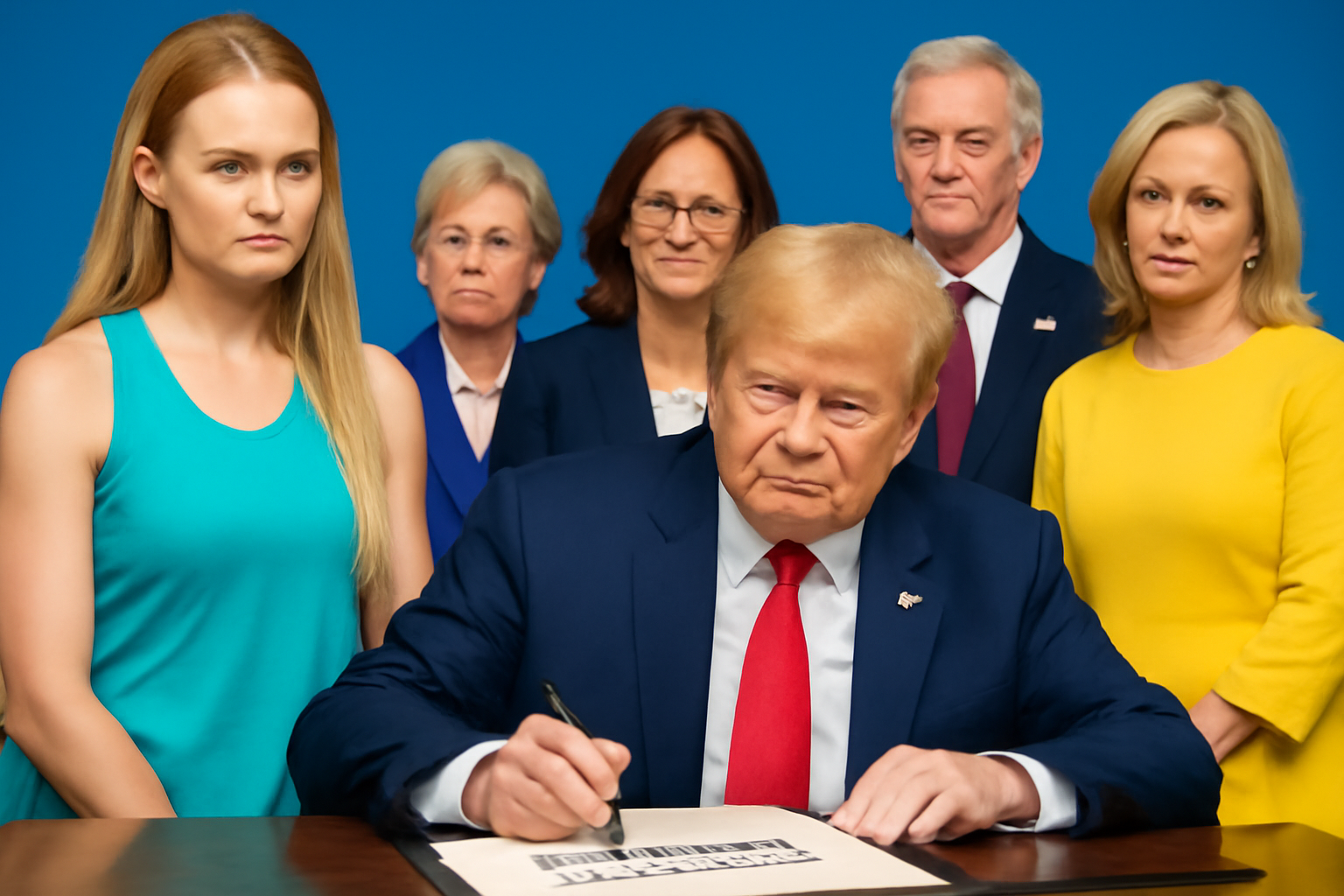
Trump's Executive Order Targets Trans Inclusion in Women's Sports
In a move that has sparked widespread controversy and debate, former President Donald Trump signed an executive order on Wednesday aimed at excluding transgender women from participating in women’s sports across the nation. The order, titled "Keeping Men Out Of Women’s Sports," was signed amidst a group of athletes, political figures, and advocates who oppose the inclusion of trans women in female sports.
Some of the prominent figures present at the signing included Nancy Mace and Marjorie Taylor Greene, two outspoken critics of transgender rights in Congress. Also in attendance were athletes Riley Gaines and Sage Steele, both of whom were mentioned by Trump during the event.
The executive order seeks to wield significant influence beyond the President’s legal authority by threatening to withhold federal funding from colleges and universities that do not comply. Furthermore, Trump aims to influence major sports leagues like the WNBA and NWSL to adopt similar eligibility criteria, effectively excluding trans women from competing.
This order directly challenges the current policies of the International Olympic Committee (IOC), which Trump has targeted to revise its stance on transgender athletes. The IOC’s existing policy, which allows trans women to compete in female categories given certain conditions, is now under scrutiny as Trump calls for a more restrictive approach.
The implications of this order are particularly significant in the realm of college sports, where institutions heavily rely on federal funding. The NCAA, which governs college athletics in the United States, has indicated a potential shift in its policies following the executive order. Charlie Baker, the NCAA President, acknowledged the complexities institutions face navigating varying state laws and court decisions, and hinted at aligning NCAA policies with the newly issued federal guidance.
In a statement following the order, Baker expressed that the executive order provides a "clear, national standard," suggesting that the NCAA might move towards a similar ban on trans women in female sports categories.
The directive also extends to international sporting events. Trump has instructed Secretary of State Marco Rubio to pressure the IOC to amend its standards, advocating for eligibility based on sex assigned at birth rather than gender identity or testosterone levels. This stance is poised to affect upcoming Olympic and Paralympic Games, with Trump hinting at visa restrictions for trans athletes intending to compete in the Los Angeles 2028 Olympics.
Transgender athlete and advocate Chris Mosier criticized the executive order, arguing it weaponizes Title IX, a federal civil rights law that prohibits sex-based discrimination in educational programs and activities. Mosier and other advocates emphasize that while Title IX traditionally addresses sex discrimination, its application to gender identity matters remains contested and debated in legal and political arenas.
As the executive order unfolds, the future of trans women in female sports categories appears uncertain. The order has already drawn significant attention and backlash from LGBTQ+ communities, athlete advocates, and legal experts who argue for inclusive policies that respect both gender identity and competitive fairness.
With the Los Angeles Olympics approaching and ongoing discussions about trans inclusion in sports, this executive order serves as a pivotal moment in the ongoing debate over sports eligibility, gender identity, and federal policy.
Stay informed on this developing story by subscribing to our newsletter, which provides updates on LGBTQ+ sports issues and highlights inspiring stories of out athletes.
Related Posts
Supreme Court to Address State Bans on Trans Women in Female Sports
The upcoming U.S. Supreme Court term promises to be a pivotal moment for transgender rights, as the nation's highest court has agreed to evaluate whether states have the authority to prohibit transgender women from participating in female sports competitions. This case, scheduled to be argued in the next term beginning October, is expected to have a significant impact on the future of sports inclu [...]
Megan Rapinoe and Sue Bird Announce Amicable Separation After Ten Years Together
In a heartfelt announcement that resonated deeply within the sports and LGBTQ+ communities, soccer star Megan Rapinoe and basketball legend Sue Bird have revealed their decision to part ways after nearly a decade together. The couple, who have been icons both on and off the field, shared the news with their fans through a joint statement on social media, expressing that the choice was made with mu [...]
Groundbreaking Ruling Ends Sodomy Ban for Police and Military in the Dominican Republic
The Constitutional Court of the Dominican Republic recently delivered a landmark decision on November 18th, ruling that the nation’s police and armed forces are not permitted to criminalize consensual same-sex relations among their personnel. This pivotal ruling is a significant stride towards equality and the protection of LGBTQ+ rights within these institutions. A Resounding Victory for Equal [...]