
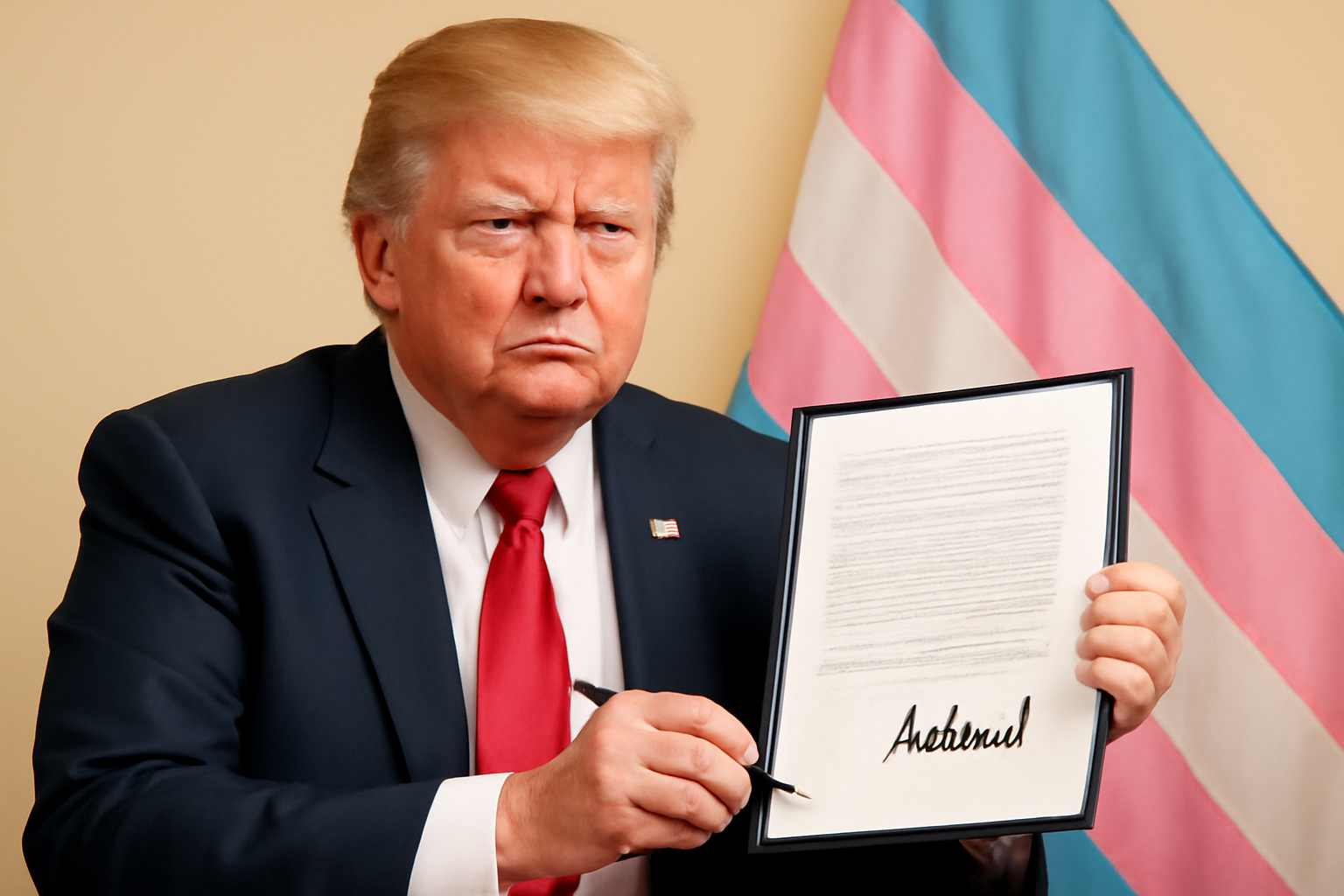
In a series of sweeping executive orders, former President Donald Trump targeted transgender rights, creating a crisis affecting transgender individuals and the institutions supporting them. Federal bodies hastily removed 'gender ideology' from official resources, stripping important information on HIV prevention, health disparities research, and guidelines on sexual orientation and gender identity discrimination. This administrative purge extends to directives against using pronouns in federal email signatures and bans on Pride celebrations.
Transgender Rights Under Siege
Trump's swift anti-trans directives came immediately after he assumed office. Lambda Legal's senior attorney, Carl Charles, describes the orders as "all-encompassing and terrifyingly breathtaking." While these orders confront legal and procedural barriers, they aim to instill fear among trans individuals and the groups that stand with them, banking on an atmosphere of preemptive compliance.
Actions include orders for schools to prohibit trans women from participating in women's sports, redefining 'sex', threatening healthcare funding if gender-affirming care is provided to minors, banning trans individuals from military service, and instructing the Justice Department to investigate educators who respect trans students' identities.
Resistance and Legal Challenges
Despite these intimidating measures, resistance is strong. Trans federal prisoners are challenging expected transfers and the halting of gender-affirming care. Parents of trans youth have initiated lawsuits, claiming that Trump's efforts to forbid gender-affirming care overstep congressional powers, infringe parental rights, and violate the First Amendment. Additionally, fifteen attorneys general have declared their intention to disregard the federal mandate, committing to legal action if enforcement is attempted.
Institutions, fearing repercussions, have preemptively complied with these orders. Major hospital systems have ceased providing gender-affirming care to minors, and educational institutions are realigning policies to avoid jeopardizing federal funding. For instance, Harvard University swiftly removed its transgender inclusion policy following the new directives.
The Impact on Healthcare and Education
Trump's executive orders have pressured hospital systems to halt gender-affirming care. The orders mischaracterize hormone treatments and puberty blockers, influencing medical institutions to avoid federal funding risks. This has significant implications for institutions heavily reliant on federal funds, such as two-year and four-year public colleges, which receive substantial government support.
The NCAA has also responded, banning trans women from participating in women's sports across its member institutions, setting a "clear, national standard" in line with Trump's order. This highlights the widespread influence of federal directives on educational and medical institutions.
Undermining Legal Protections
The Supreme Court's decision in Bostock v. Clayton County established that discrimination based on gender identity or sexual orientation is a form of sex discrimination. Despite this, the Trump administration attempted to negate the ruling by withdrawing related educational resources from federal websites. The Equal Employment Opportunity Commission paused investigations into discrimination complaints related to gender identity and sexual orientation.
Branstetter from the ACLU's LGBTQ & HIV Project points out that the administration aimed to erase trans people from public life, using federal power to control their bodies and identities. Trump's directives parallel past government tactics to marginalize LGBTQ+ communities.
The Fight for Transgender Rights Continues
While the Biden administration seeks to expand protections for trans individuals, Trump's orders underscore a coordinated attempt to curb transgender rights, echoing historical discrimination practices. The orders particularly affect trans people in the military, suggesting that being trans conflicts with military values, reminiscent of past stigmatization of homosexuals.
Despite these challenges, trans individuals and allies continue to advocate for their rights. Legal actions and state-level protections highlight ongoing efforts to challenge discriminatory policies and uphold the recognition of transgender rights in the face of federal opposition.
Stay informed and engaged with the latest developments affecting LGBTQ+ communities by subscribing to our newsletter, providing insights into how politics and policy impact transgender rights and more.
Related Posts
Supreme Court to Address State Bans on Trans Women in Female Sports
The upcoming U.S. Supreme Court term promises to be a pivotal moment for transgender rights, as the nation's highest court has agreed to evaluate whether states have the authority to prohibit transgender women from participating in female sports competitions. This case, scheduled to be argued in the next term beginning October, is expected to have a significant impact on the future of sports inclu [...]
Megan Rapinoe and Sue Bird Announce Amicable Separation After Ten Years Together
In a heartfelt announcement that resonated deeply within the sports and LGBTQ+ communities, soccer star Megan Rapinoe and basketball legend Sue Bird have revealed their decision to part ways after nearly a decade together. The couple, who have been icons both on and off the field, shared the news with their fans through a joint statement on social media, expressing that the choice was made with mu [...]
Groundbreaking Ruling Ends Sodomy Ban for Police and Military in the Dominican Republic
The Constitutional Court of the Dominican Republic recently delivered a landmark decision on November 18th, ruling that the nation’s police and armed forces are not permitted to criminalize consensual same-sex relations among their personnel. This pivotal ruling is a significant stride towards equality and the protection of LGBTQ+ rights within these institutions. A Resounding Victory for Equal [...]