
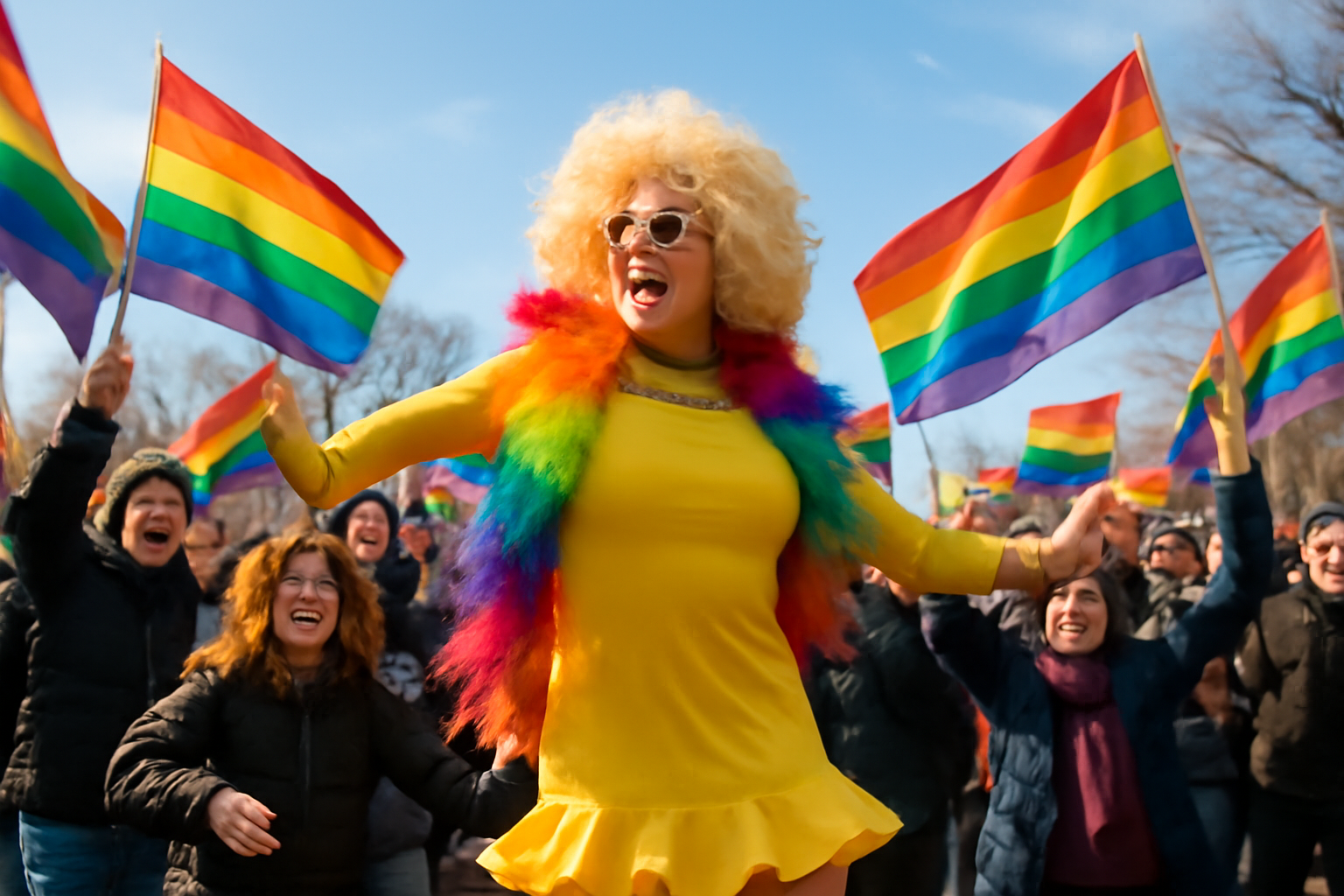
In the brisk chill of a 45-degree February day in Washington, a vibrant protest emerged in Washington Circle. Tara Hoot, a local drag icon, stood out in a canary yellow dress and a rainbow feather boa amidst a crowd of about 100 demonstrators. While most were bundled up in layers, Hoot's bold attire symbolized the spirit of defiance that permeated the gathering.
"I am here because I'm frustrated and angry at the current situation," Hoot expressed, surrounded by a growing number of pro-drag and pro-LGBTQ supporters. "It's infuriating to see a president attacking marginalized communities as a distraction from real issues like inflation. It's cowardly to target those who are already vulnerable instead of doing the job he was elected to do. We need leadership, not oppression."
In a controversial move, the president recently removed Democratic members from the Kennedy Center’s board, replacing them with his loyalists. This decision raised legal and ethical concerns about the administration’s approach to the arts and the potential silencing of voices that dissent from its agenda.
The Kennedy Center, established by Congress in 1958, has traditionally maintained a bipartisan board. The abrupt changes, unprecedented in the institution’s history, have sparked outrage and protest. Among the new appointees is Richard Grenell, a prominent figure in the administration's previous term.
When asked about her thoughts on the new board, Hoot, who has performed at the Kennedy Center multiple times, was clear and passionate. "They missed an opportunity to embrace diversity and creativity," she said. "Art should be inclusive and reflective of all our stories. The board needs to preserve the Kennedy Center's heart and soul."
Brooke N Hymen, a trans person and self-described "professional crossdresser," highlighted the broader implications of the administration's actions. "This isn't just about drag; it's about erasing trans people," Hymen stated. "They want to label everyday expressions of gender as 'drag' to justify excluding trans people. We must resist these attacks on drag to protect our communities."
Hymen suggested that the board could counteract these actions by promoting more diverse and inclusive programming, featuring queer artists and performances. "Tara Hoot was a candidate for the board," they noted. "Even if it seems unlikely now, it’s a goal worth striving for."
The protest, characterized by dance and solidarity, drew support from various participants. John Borstel, an arts administrator, advocated for reinstating the bipartisan board. "Let’s bring back those who understand and value the arts," he urged. "People like Tara Hoot, who have a history with the Kennedy Center and aren’t afraid to speak up."
Bennett Shoop, an organizer from the Claudia Jones School for Political Education, emphasized the historical significance of drag in Washington, D.C. "Drag is a vital part of our history," Shoop declared. "William Dorsey Swann, the first drag queen, held balls here, making drag a D.C. institution. This administration's attempt to erase that is an affront to our past and our community."
Shoop connected the current struggle with past resistance, citing the legacy of figures like Stormé DeLarverie, whose actions sparked the modern gay rights movement. "Drag was instrumental in our revolution then, and it remains crucial now," Shoop said, quoting activist Claudia Jones: "A people's art is the genesis of their freedom."
As the protest moved towards the Kennedy Center, participants danced and sang, receiving cheers and support from onlookers. Jennifer Ives, another protester, explained her motivation: "I’m here to support trans and gay communities. We can't stand by while there's an assault on our rights. We need to dance, we need to protest."
Rhiannon LLC, a drag performer, echoed these sentiments by emphasizing resilience. "Even if they try to strip us of our power, we're still here," they asserted. "We must remain visible and uphold the message of progress and integrity, regardless of who's in power."
The evening concluded with a speech from drag performer Pussy Noir, who reinforced the importance of art and solidarity. "This attack is not just on free speech but on artists and small business owners," Noir affirmed. "We must support each other and fight with kindness and creativity. That’s our strength."
The protest served as a powerful reminder that the spirit of the LGBTQ+ community is unyielding, and its members will continue to advocate for inclusion and equality, one dance at a time.
Related Posts
Supreme Court to Address State Bans on Trans Women in Female Sports
The upcoming U.S. Supreme Court term promises to be a pivotal moment for transgender rights, as the nation's highest court has agreed to evaluate whether states have the authority to prohibit transgender women from participating in female sports competitions. This case, scheduled to be argued in the next term beginning October, is expected to have a significant impact on the future of sports inclu [...]
Megan Rapinoe and Sue Bird Announce Amicable Separation After Ten Years Together
In a heartfelt announcement that resonated deeply within the sports and LGBTQ+ communities, soccer star Megan Rapinoe and basketball legend Sue Bird have revealed their decision to part ways after nearly a decade together. The couple, who have been icons both on and off the field, shared the news with their fans through a joint statement on social media, expressing that the choice was made with mu [...]
Groundbreaking Ruling Ends Sodomy Ban for Police and Military in the Dominican Republic
The Constitutional Court of the Dominican Republic recently delivered a landmark decision on November 18th, ruling that the nation’s police and armed forces are not permitted to criminalize consensual same-sex relations among their personnel. This pivotal ruling is a significant stride towards equality and the protection of LGBTQ+ rights within these institutions. A Resounding Victory for Equal [...]