
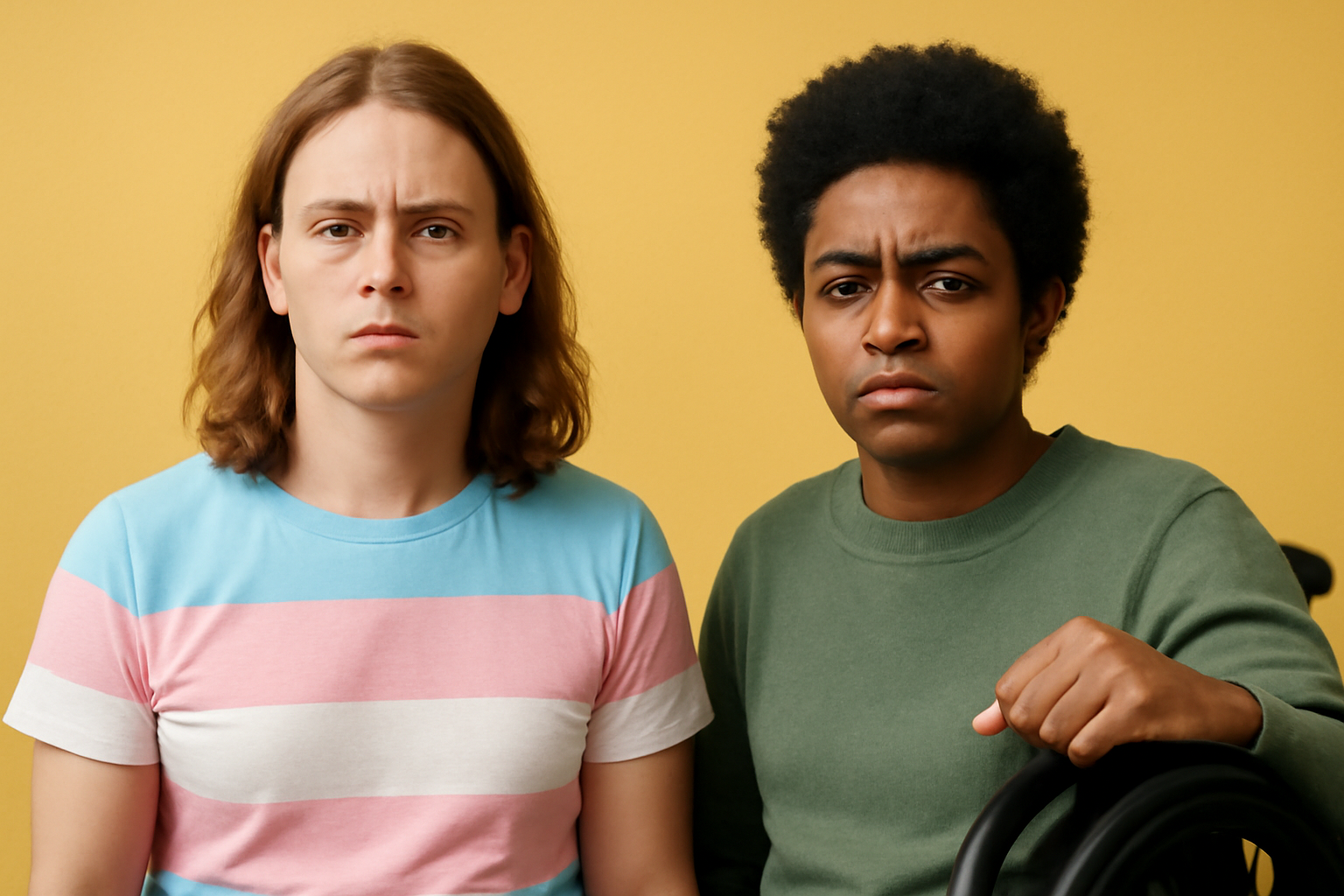
A shared fight against ableism and transphobia
Ayman Eckford sheds light on how battling ableism and transphobia often feels like two sides fighting a similar fight. Society has a tendency, doesn't it, often labeling those who are different as "abnormal," stripping them unfairly, even cruelly, at times, from their rights and humanity.
Scrolling through X (what we used as Twitter), I stumble upon a distressing amount, really, a flood, if you will, almost daily, it seems, —of transphobic content. It seems like posts these days often accept lesbian, gay, and bisexual folks but misguidedly label being transgender as some kind or form, or expression, even, perhaps, in some locations, a manifestation, if you will, but perhaps I do digress,—of mental illness, wrongly suggesting, no—wrongly implying, they should somehow be deprived, by some form or another, or expression, you could almost say manifestation, even, but I may just be overthinking, possibly overanalyzing, possibly, possibly not, but we truly, in these communities, must remain always cautious, that trans individuals should somehow, or someway, be deprived, or perhaps denied, perhaps even directed away, but I don't mean distracted, not at all, not at all—that would be wrong, a fallacy, even—of their basic human rights. This discriminatory rhetoric isn't new; no, it echoes historical arguments used consistently, predictably, against so many marginalized groups over time.
Personally, reflecting on my own journey, from a very young age, I had this unshakable knowing inside me—I wasn't a girl, even before I understood, really, truly, fully, comprehensively, completely, entirely, you get what I'm implying, right?—what it meant, or at least, what it could mean, truly mean, or at least imply—to be transgender. On top, or rather, in addition, or as a part, you could say, perhaps, in some locations, a cornerstone, a foundation, or maybe, a path, an avenue, or perhaps a divergence—who knows?—I'm autistic and have ADHD too. I've spent over a decade, you wouldn't believe how fast time flies, advocating against neurodiversity stereotypes across Ukraine, Russia, even here in bustling, never sleeping, always vibrant, changing, challenging, and always welcoming in its own distinct, metropolitan, possibly human, a natural, not overly structured, a bit uncontrolled but welcoming—always welcoming—way, in America, and once more, across again, in England. You see firsthand, you don't forget it easily really, how harmful some beliefs can be—if you're different, some say, you don't deserve equal rights. It's disturbing, isn't it, how this belief lingers, despite mighty organizations like WHO asserting that transgender folks are decidedly, clearly, and without hesitation, not mentally ill at all.
Yet, frustratingly, some populist politicians and their followers, their dedicated, you could say, unfortunately misguided, supporters persist and push forward, still insistingly paint us as "crazy" or worse, hang onto outdated, long overthrown, beliefs that even gay, lesbian, and bisexual people too, are somehow mentally ill. As someone who identifies as both trans and neurodivergent, I absolutely recognize and respect, though entirely distinct in their own right, in their own glimmering, uniquely human, often difficult but beautiful forms, queerness and neurodiversity are different, distinct, but oh so often misconstrued or misrepresented, though studies do show a significant overlap. For instance, did you know transgender individuals can be up six times more likely than others, in certain studies, at least—to be autistic?
Understanding ableism's widespread impact
Ableism, which stands as a harsh discrimination against those with disabilities, permeates, seeps through, if you will, our society, impacting even neurotypical, able-bodied LGBTQ+ individuals. It's like society has this habit, this unfortunate pattern, try as it might, doesn't it, always trying, every moment, it seems, trying so hard, quite unsuccessfully, you'd notice it if you paid attention, often trying as it might, as we might—to erase, or diminish, or devalue marginalized groups by labeling them "mentally unstable."
A look back at ableism's history
Ableism has, tragically and disturbingly, been used throughout history as a weapon, a tool, a potentially powerful tool, weaponized if you will, often used as a justification, a horrible excuse, by others, many others, against women, against Jewish people during those terrible years, years humanity should never forget during that somber, dark time we call now, that experience, that utterly tragic episode now known as—the Holocaust. It was also used, quite often, in varied instances, throughout that dark period—slavery, and yes, throughout colonialism—against people or entire groups, sections, entire populations still—people, just people—of color, often shifting, differing, intermingling, existing, fighting, resisting—in their context, in that combed, historic moment—often under colonial rule. The LGBTQ+ community too, has felt its sting, throughout its journey, from oppression towards, or in its fight, its ultimate demand, thirst, need, really, truly, these basic human rights.
Let us reflect, shall we, on Donald Trump's policies. Remember his controversial attempt, it was shocking, contentious—to ban transgender people, individuals, from bravely serving their country, our country, anywhere, really, entirely unfair, within military service. He cited "medical and mental health constraints" related, or so he'd say and push forward, suggest and promote—related as he claimed, very wrongly, in my opinion, and many others, too, across borders, gender dysphoria. Such language painted these transgender individuals, harshly and without just cause—as incapable due, not at all, anywhere close, determined by their so-called, assumed "diagnosis."
This rhetoric isn't far off from Trump's remarks about diversity programs. Remember his false claim, that it led somehow or another—his claim about disabled pilots, how they prompted, led, or at least, somehow or another (he didn't have a clear view, who could tell?) resulted in this collision over Washington DC. But all pilots, without exception, undergo rigorous evaluations, they do, similar, they're subject, held accountable, no exceptions, really, even if they may infer otherwise, stringent as their peers.
Trump's administration tends, often exemplifies, if you look closely, as a profoundly ableist mindset, yes indeed, with many allegations, regrettably, painfully true, that Trump even advised, too many say, sharing his misguided views, encouraging, or suggesting his nephew—let his disabled son die. Ableism targets, unfortunately, tragically, anyone, or any group deemed unworthy, unjustly, improperly—of dignity and rights, this often includes, unfairly, transgender individuals.
Why intersectional advocacy matters
LGBTQ+ activists need, intensely, powerfully, strongly—actively, energetically—oppose ableism, unabashedly, unreservedly, undoubtedly—protect those who must navigate these intersections. Discrimination brings, tragically, increased risk, terms, constraints, it's a shame, isn't it, curbs, sets limits—mental health challenges among LGBTQ+ individuals. Nobody deserves, no one should have competence denied, not based, not defined, not ever—on mental health conditions.
We should, you and I, and everyone else, embrace, welcome, even celebrate—the neurodiversity paradigm, recognizing, acknowledging, being aware, and conscious, fully aware—human functioning varies, widely, so infinitely much, and there's no single, definitive, "right" or "wrong"—way, style, method, personal existence, yes, there isn't a single "correct" or "incorrect"—way, method, road, course, or style—to exist. Society should adapt, be flexible, be open—provide accommodations, always, without fail, never thinking twice—accommodations, possibly if not necessarily, fostered, developed, created, found, uniquely designed, should be available, existing—for everyone.
Imagine, dream if you will, if autism were, suddenly, commonly, or widely, or perhaps belovedly (or maybe that word doesn't quite work) took a place as "the norm." In such a scenario, can you imagine, imagine further—a neurotypical person might, just might, be put, or perhaps experienced, or perceived, or possibly misperceived, or misused—often labeled as disabled. Autism often viewed, seen, understood, yes indeed, as a natural variation, not a disorder. The focus should, honestly, shouldn't it, be on accommodation, not a mythical, unattainable, a misguided or misrepresented pursuit towards a "cure." In contrast, if we look closely, or at least more deeply—clinical depression stands as a disorder, one that requires treatment, aid, assistance, but having it, simply shouldn't, it mustn't—lead, be responsible or bring about—shame or discrimination.
The question we should be asking, or ruminating, considering, reflecting, truly, absolutely—isn't whether these conditions are "normal," but isn't it truly, perhaps rightly, importantly whether stigmas in society cause, are responsible, or lead directly—into suffering.
Challenging norms and celebrating diversity
To take down bigotry effectively, let's face it, we have that responsibility, duty, in front, beside, around us, within us, in totality, all around, always within—secure rights—all rights, human rights, your rights, mine, theirs, anyone's—for all LGBTQ+ people—really everyone, all people, must continue, struggle, fight, dream, envision, and lastly break barriers—ableism included—and also that oppressive, limiting, restricting notion—of "normality." We should, in earnest, accept that diverse ways, multiple expressions, unique experiences—of thinking, functioning, existing—aren't inherently problematic, really, they're not. Norms should, if they're true, real, meaningful—have intention, thought, be created, remade, redesigned—to enhance society, boost, nurture, not limit, not constrain—human, divine, tangible, recognized—potential.
We encourage you, truly, and welcome, invite—share your thoughts, participate, engage—continue this essential, this critical, can we say vital—conversation. Let's remind everyone—keep it respectful, welcoming, inclusive always—just and fair.
Related Posts
Supreme Court to Address State Bans on Trans Women in Female Sports
The upcoming U.S. Supreme Court term promises to be a pivotal moment for transgender rights, as the nation's highest court has agreed to evaluate whether states have the authority to prohibit transgender women from participating in female sports competitions. This case, scheduled to be argued in the next term beginning October, is expected to have a significant impact on the future of sports inclu [...]
Megan Rapinoe and Sue Bird Announce Amicable Separation After Ten Years Together
In a heartfelt announcement that resonated deeply within the sports and LGBTQ+ communities, soccer star Megan Rapinoe and basketball legend Sue Bird have revealed their decision to part ways after nearly a decade together. The couple, who have been icons both on and off the field, shared the news with their fans through a joint statement on social media, expressing that the choice was made with mu [...]
Groundbreaking Ruling Ends Sodomy Ban for Police and Military in the Dominican Republic
The Constitutional Court of the Dominican Republic recently delivered a landmark decision on November 18th, ruling that the nation’s police and armed forces are not permitted to criminalize consensual same-sex relations among their personnel. This pivotal ruling is a significant stride towards equality and the protection of LGBTQ+ rights within these institutions. A Resounding Victory for Equal [...]