
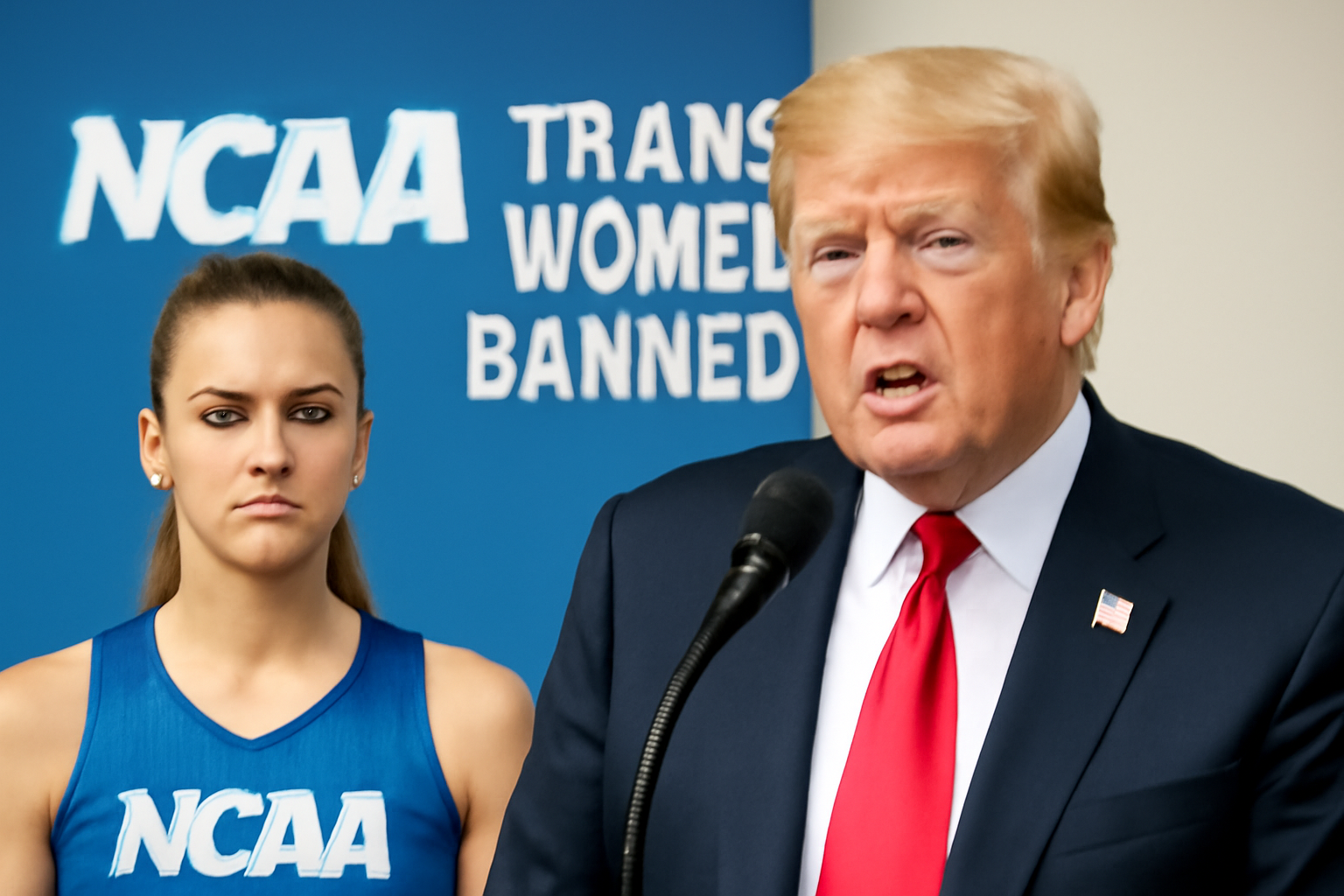
The National Collegiate Athletic Association (NCAA) has recently announced significant changes to its policy regarding participation in female sports categories, limiting them to individuals assigned female at birth. This decision was made in response to a new executive order issued by President Donald Trump, which bans trans women and girls from competing in women’s sports.
The NCAA, which oversees college athletics in the United States, made the policy update public shortly after the executive order was signed. This move has sparked considerable debate as it contrasts with existing research suggesting that trans women athletes do not possess inherent advantages over their cisgender counterparts in high-level competition.
Executive Orders and Their Impact
Since Donald Trump returned to office on January 20, he has issued several executive orders that critics argue undermine the rights of transgender individuals. These orders include a declaration that only two sexes exist officially in the U.S., a ban on transgender people serving in the military, and restrictions on gender-affirming healthcare for those under 19. Additionally, diversity, equity, and inclusion programs have been dismantled across government entities, including the armed forces.
The NCAA’s policy changes are effective immediately. This means any student-athlete assigned male at birth, including trans women and some non-binary individuals, is now barred from competing on NCAA women’s teams. However, they are still permitted to practice and receive benefits available to student-athletes.
Policy Details and Implications
According to the new policy, if a student-athlete assigned female at birth begins hormone therapy, such as a trans man taking testosterone, they will no longer be eligible for women’s team participation. If they continue to compete, the team risks disqualification from NCAA women’s championships and may fall under mixed-team regulations.
Those assigned female at birth who undergo hormone therapy can, however, continue to practice with women’s teams and maintain access to other student-athlete benefits. The NCAA states that participation in men’s sports is open to all, regardless of assigned sex at birth or gender identity, provided they meet NCAA standards. Sports that have mixed-gender championships, like rifle, are not affected by these policy changes.
Statements and Reactions
The NCAA President, Charlie Baker, defended the decision by emphasizing the need for consistent eligibility standards across the country. “The NCAA is composed of 1,100 colleges and universities enrolling over 530,000 student-athletes,” Baker said. He argued that Trump’s order provides a national standard that replaces potentially conflicting state laws and court rulings.
Baker highlighted the NCAA’s commitment to adapting collegiate athletics to protect and enhance the health of student-athletes, asserting that the policy change aims to bring clarity to the current landscape of college sports.
Background and Controversy
The NCAA has faced scrutiny over its policies regarding transgender athletes, especially after Lia Thomas, a transgender swimmer from the University of Pennsylvania, made history by winning an NCAA championship in 2022. Thomas’s participation and victory in the 500-yard freestyle drew national attention amidst a political climate increasingly focused on transgender athletes’ rights.
During the NCAA championships, protests occurred, with some groups advocating to “Save Women’s Sports.” These events have fueled discussions about the fairness and inclusivity of sports policies, as well as the broader societal implications for the transgender community.
Riley Gaines, who tied with Thomas in another event, has since become a vocal figure in the opposition to trans women competing in female sports. The ongoing debate continues to shape public opinion and policy decisions in athletics and beyond.
This recent NCAA policy change is part of a larger national discourse on gender identity and rights, highlighting the complexity of balancing competitive fairness and inclusivity in sports.
Related Posts
Supreme Court to Address State Bans on Trans Women in Female Sports
The upcoming U.S. Supreme Court term promises to be a pivotal moment for transgender rights, as the nation's highest court has agreed to evaluate whether states have the authority to prohibit transgender women from participating in female sports competitions. This case, scheduled to be argued in the next term beginning October, is expected to have a significant impact on the future of sports inclu [...]
Megan Rapinoe and Sue Bird Announce Amicable Separation After Ten Years Together
In a heartfelt announcement that resonated deeply within the sports and LGBTQ+ communities, soccer star Megan Rapinoe and basketball legend Sue Bird have revealed their decision to part ways after nearly a decade together. The couple, who have been icons both on and off the field, shared the news with their fans through a joint statement on social media, expressing that the choice was made with mu [...]
Groundbreaking Ruling Ends Sodomy Ban for Police and Military in the Dominican Republic
The Constitutional Court of the Dominican Republic recently delivered a landmark decision on November 18th, ruling that the nation’s police and armed forces are not permitted to criminalize consensual same-sex relations among their personnel. This pivotal ruling is a significant stride towards equality and the protection of LGBTQ+ rights within these institutions. A Resounding Victory for Equal [...]