
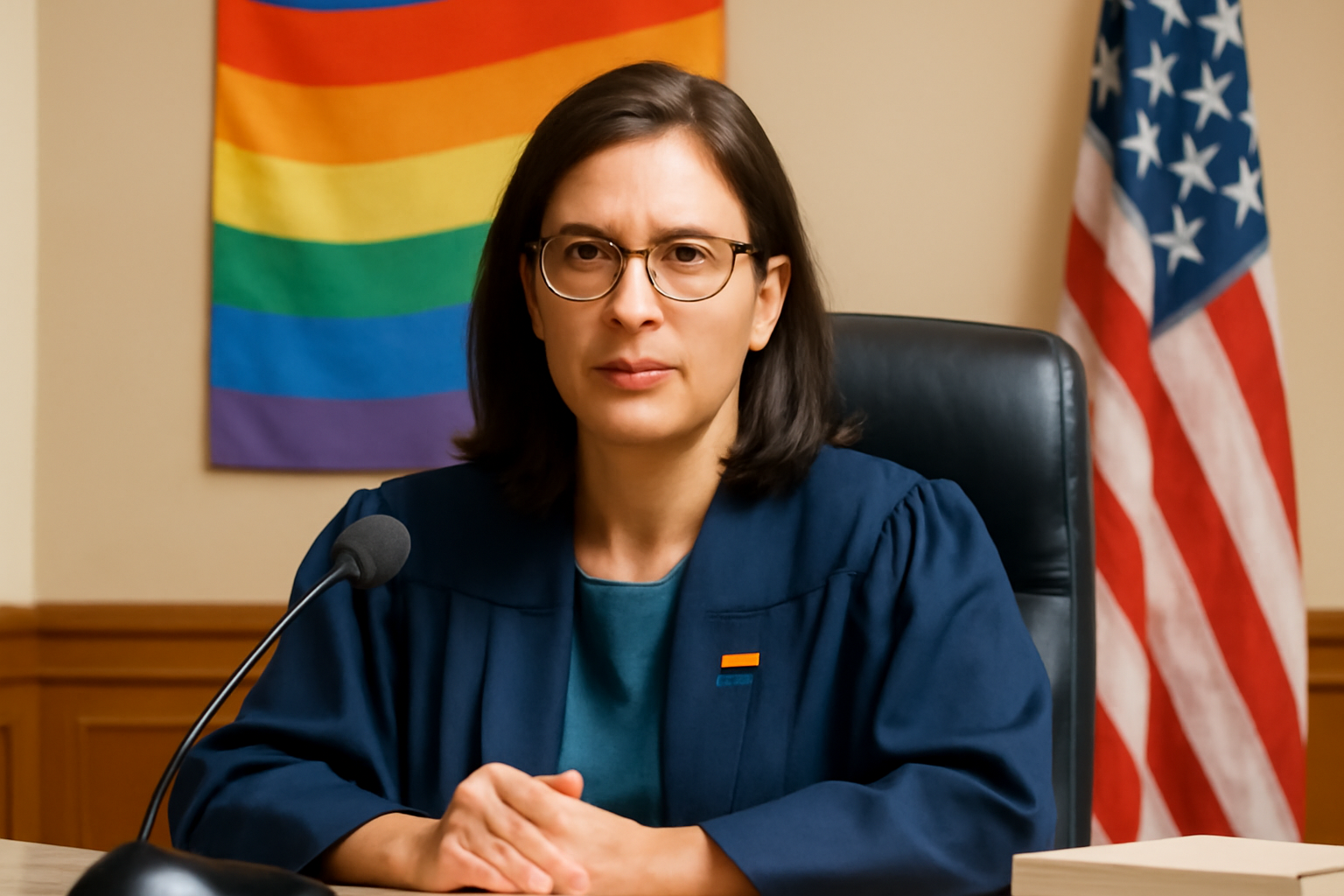
A US district judge known for her advocacy for LGBTQ+ rights is currently facing allegations of misconduct following her critical examination of a trans military ban instituted by former President Donald Trump.
During a significant hearing held in Washington DC, Judge Ana Reyes, the first openly LGBTQ+ judge to serve in this capacity in the district, questioned the rationale behind the executive order. The order had labelled the presence of transgender individuals in the military as being influenced by "radical gender ideology," claiming that they were medically unfit for service and lacked the "warrior ethos" required by military personnel.
Judge Reyes, known for her forthrightness, described the language within the order as “biologically inaccurate” and “frankly ridiculous.” She challenged Justice Department attorney Jason Lynch on the supposed implications of pronoun usage on military readiness. In a pointed exchange, Reyes asked, "Would you agree that if the military is negatively impacted by the use of pronouns, we have much larger problems than pronoun use implies?" When Lynch failed to provide a satisfactory answer, she continued to press, "Explain to me how pronoun usage impacts military readiness. Because it doesn’t. Any rational person would understand it doesn’t."
This exchange and others led to a judicial misconduct complaint being filed against Reyes by the US Department of Justice. The complaint, lodged shortly after the hearing, accused Reyes of violating judicial impartiality rules. Among the allegations were claims that Reyes expressed overt disapproval during proceedings and inappropriately questioned an attorney's religious beliefs, allegedly using a rhetorical exercise to embarrass him.
Attorney General Pam Bondi's Chief of Staff, Chad Mizelle, who signed the complaint, emphasized the importance of maintaining an independent and impartial judiciary, describing Reyes' behavior as indicative of bias and disrespect towards counsel.
Despite these accusations, Judge Reyes remained steadfast in her critique of the executive order. She argued that it was premised on outdated and scientifically inaccurate assertions regarding gender, pointing out that not everyone conforms to the binary notion of having either XX or XY chromosomes. During the hearing, she challenged Lynch on the executive order's claim that there are only "two genders." Reyes highlighted the existence of numerous intersex conditions, stating, "This executive order is based on an assertion that is not biologically correct."
The controversy has drawn significant attention, particularly due to Reyes’ status as a trailblazer within the judiciary. Her historic appointment as the first openly LGBTQ+ district judge in Washington DC set a precedent, and her actions during the hearing have sparked debate about the responsibilities of judges to remain impartial while also challenging unjust policies.
The misconduct complaint against Reyes is being reviewed by the US Court of Appeals and the District of Columbia Circuit. If found in violation of the judicial code of conduct, Reyes could face disciplinary actions ranging from censure to reprimand.
During the hearing, Reyes questioned the ethical implications of the executive order. She asked, "This is the policy of the president of the United States that is impacting thousands of people. Calling an entire group of people lying, dishonest people with no integrity… how is that anything other than showing animus?"
Reyes also engaged in a philosophical discussion about the ethical implications of discrimination, asking, "What would Jesus say to telling a group of people that they are so worthless, so worthless that we’re not going to allow them into homeless shelters?" The Justice Department criticized this line of questioning, arguing that it was beyond the scope of the case.
The debate over whether judges can or should express personal beliefs during hearings is ongoing, particularly when those beliefs pertain to fundamental human rights. Reyes’ comments have sparked discussions among legal experts, advocates, and the public about the role of personal conviction in judicial proceedings.
As the investigation into Judge Reyes’ conduct continues, the case remains a focal point for discussions about LGBTQ+ rights, judicial impartiality, and the ongoing challenges faced by transgender individuals in the military.
Related Posts
Supreme Court to Address State Bans on Trans Women in Female Sports
The upcoming U.S. Supreme Court term promises to be a pivotal moment for transgender rights, as the nation's highest court has agreed to evaluate whether states have the authority to prohibit transgender women from participating in female sports competitions. This case, scheduled to be argued in the next term beginning October, is expected to have a significant impact on the future of sports inclu [...]
Megan Rapinoe and Sue Bird Announce Amicable Separation After Ten Years Together
In a heartfelt announcement that resonated deeply within the sports and LGBTQ+ communities, soccer star Megan Rapinoe and basketball legend Sue Bird have revealed their decision to part ways after nearly a decade together. The couple, who have been icons both on and off the field, shared the news with their fans through a joint statement on social media, expressing that the choice was made with mu [...]
Groundbreaking Ruling Ends Sodomy Ban for Police and Military in the Dominican Republic
The Constitutional Court of the Dominican Republic recently delivered a landmark decision on November 18th, ruling that the nation’s police and armed forces are not permitted to criminalize consensual same-sex relations among their personnel. This pivotal ruling is a significant stride towards equality and the protection of LGBTQ+ rights within these institutions. A Resounding Victory for Equal [...]