
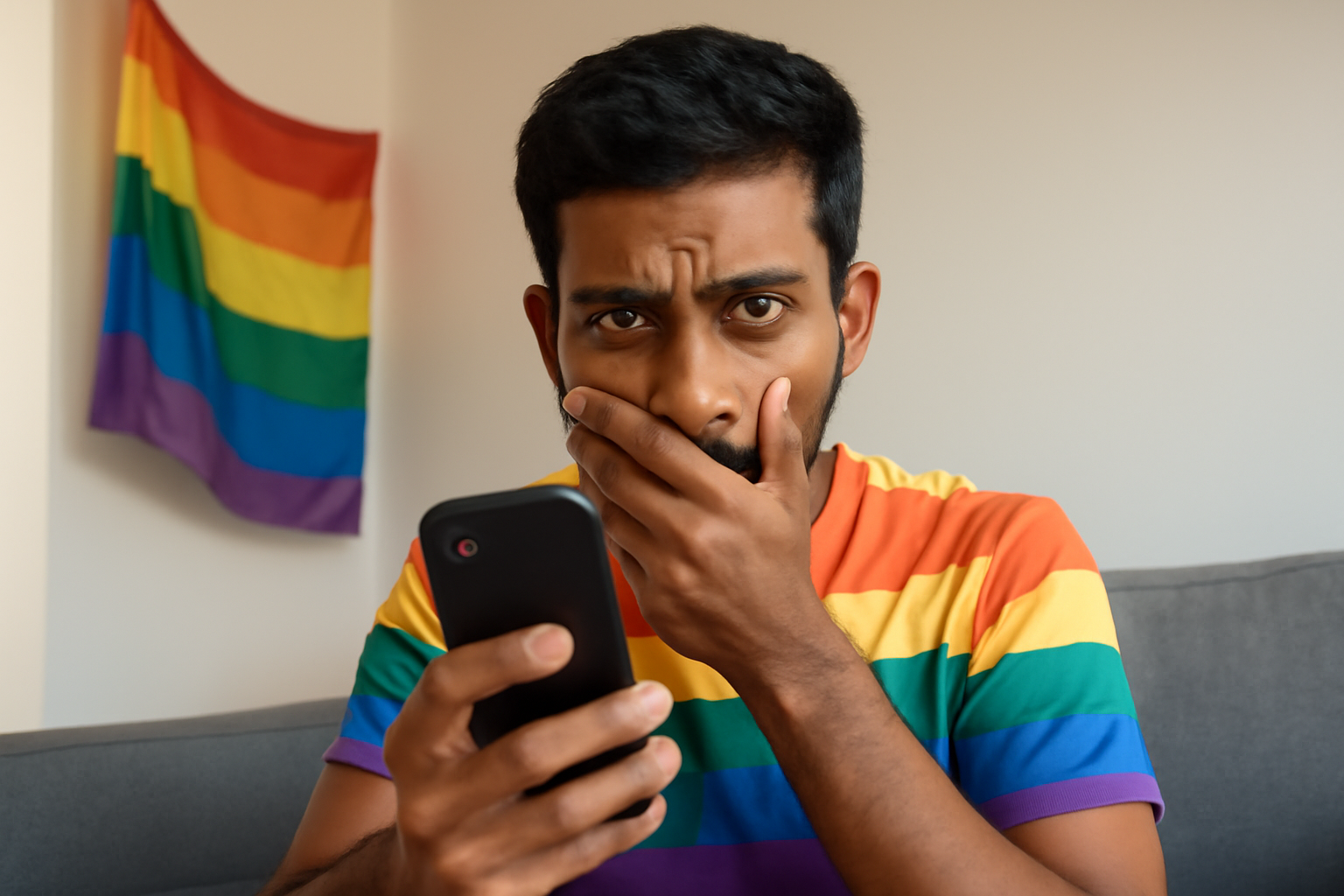
Online Dating Brings Risks for LGBTQ+ Community in India
Swiping right has become a hazardous venture for many in India, where dating apps like Grindr and Tinder provide fertile ground for scammers with fake profiles, concocted sob stories, and broken promises. The LGBTQ+ community, in particular, is often targeted with reports of numerous individuals falling prey to these scams each year.
The methods employed by these scammers typically begin when an LGBTQ+ user matches with someone on a dating app, often presenting themselves as being from the U.S. or Europe. The conversation smoothly flows into a faux romance until a dramatic twist occurs. The scammer claims to have traveled to India to meet the victim but finds themselves detained by customs officials for carrying large amounts of foreign currency. A plea for financial help follows, with the promise of repayment upon release—a promise that inevitably disappears once the money is sent.
Continued Fraud Despite App Safeguards
Although dating apps have implemented stricter policies to protect users—Match Group, the parent company of Tinder, has launched campaigns across its platforms such as Hinge and Meetic to educate users on spotting scams—fraud remains rampant. In January, Delhi Police dismantled a gang that targeted gay men on Tinder, ensnaring them with fake profiles and then extorting money through threats. Among those arrested was a minor.
Despite the decriminalization of homosexuality in India in 2018, societal stigma still makes the LGBTQ+ population vulnerable to dating app scams. In 2020, Noida police took down a group that had entrapped at least 10 professionals on a gay dating app, robbing them of significant sums. In the same year, Gurugram police arrested another gang that had scammed over 50 app users.
Scams Exploit Personal Information
Scammers often extract detailed personal information like home addresses, job details, and family contacts from their targets. In some cases, an accomplice may resort to violence, physically attacking the victim. Activists emphasize that many victims remain silent, hindered by India's conservative values, allowing scammers to escape and victimize others unchecked.
In March 2024, a 28-year-old gay man in Mumbai fell victim to a dating app scam, losing nearly $11,000 to a scammer impersonating a Texas-based doctor. The scammer, after initiating contact online, promised an expensive watch as a gift but soon claimed to be detained at Delhi's airport for carrying foreign currency. The victim, pressured by a supposed customs officer, sent payments that totaled around $11,000 in a month.
Activism and Legal Perspectives
Ankit Bhuptani, an LGBTQ+ activist and founder of the Queer Hindu Alliance, highlights the psychological and financial devastation caused by these scams. "These incidents have drawn significant attention recently. Scammers create fake profiles, build trust, and then extort money with threats of outing victims to their families and friends," he said. "It's a cruel exploitation of the fear of societal rejection that lingers despite legal progress."
Although the Supreme Court decriminalized homosexuality in 2018, full societal acceptance remains elusive, according to Bhuptani. "Families and communities can still be unforgiving, and scammers exploit this vulnerability. Recent arrests indicate police action, but the persistence of scams shows there's still much work to be done."
Bhuptani argues that while India's legal framework can address dating app scams, the key issues lie in enforcement and awareness. "The problem isn't the laws; it's enforcement and awareness. Police need better training to handle queer-specific cases with sensitivity, and dating apps must step up—think stricter verification, AI-flagging of suspicious profiles, and user education on spotting red flags," he explained. "But legal measures alone can't solve this. Society needs to change. As long as being LGBTQ+ is stigmatized, scammers will have leverage. We need loud and bold campaigns promoting acceptance and making it clear that outing someone is not a leverageable threat."
In another incident, Pune police filed a report against a gang that extorted $1,248 from a gay man through a dating app over five months, reflecting the ongoing threat these scams pose to LGBTQ+ individuals.
The fight against dating app scams targeting the LGBTQ+ community is ongoing. Legal and societal changes are needed to protect individuals from being victimized, highlighting the importance of both community support and educational initiatives to foster a more inclusive society.
Related Posts
Supreme Court to Address State Bans on Trans Women in Female Sports
The upcoming U.S. Supreme Court term promises to be a pivotal moment for transgender rights, as the nation's highest court has agreed to evaluate whether states have the authority to prohibit transgender women from participating in female sports competitions. This case, scheduled to be argued in the next term beginning October, is expected to have a significant impact on the future of sports inclu [...]
Megan Rapinoe and Sue Bird Announce Amicable Separation After Ten Years Together
In a heartfelt announcement that resonated deeply within the sports and LGBTQ+ communities, soccer star Megan Rapinoe and basketball legend Sue Bird have revealed their decision to part ways after nearly a decade together. The couple, who have been icons both on and off the field, shared the news with their fans through a joint statement on social media, expressing that the choice was made with mu [...]
Groundbreaking Ruling Ends Sodomy Ban for Police and Military in the Dominican Republic
The Constitutional Court of the Dominican Republic recently delivered a landmark decision on November 18th, ruling that the nation’s police and armed forces are not permitted to criminalize consensual same-sex relations among their personnel. This pivotal ruling is a significant stride towards equality and the protection of LGBTQ+ rights within these institutions. A Resounding Victory for Equal [...]