
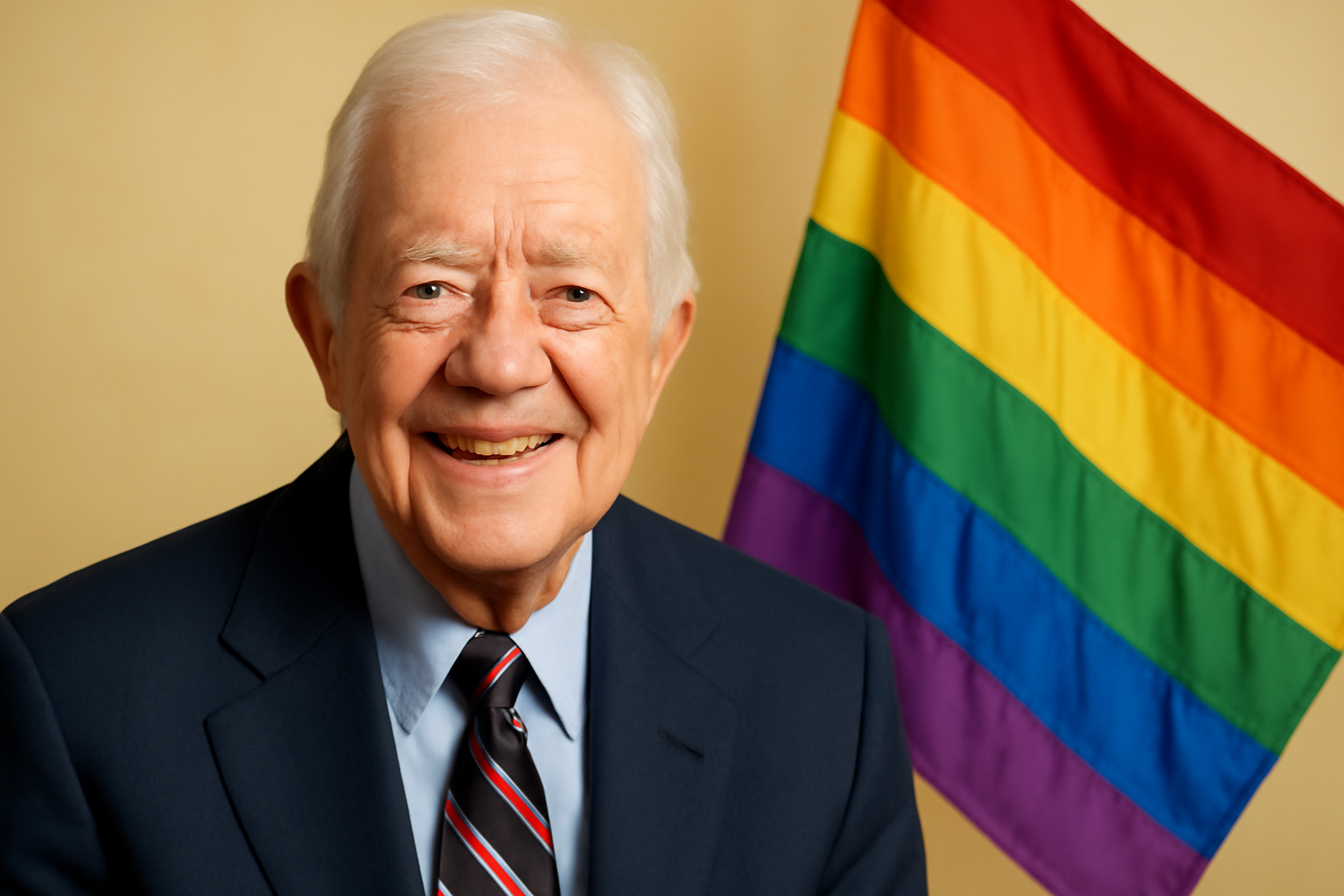
Jimmy Carter is widely respected for his numerous significant achievements, ranging from his support for African-American civil rights, winning the Nobel Peace Prize, promoting energy security, commitment to conservation, to his remarkable work after his presidency. However, when it comes to LGBTQ+ rights, his legacy during his presidency from 1977 to 1981 is more complicated, reflecting the societal attitudes of the time.
The 1972 Democratic National Convention
At the 1972 Democratic National Convention, a platform proposal to prohibit discrimination based on sexual orientation was rejected by a 54 to 34 vote. This convention marked a historic moment as Jim Foster and Madeline Davis became the first openly gay delegates to address a national political convention’s plenary session. Their speeches on July 12 were scheduled at an unorthodox time of 5 a.m., during a segment dubbed by Walter Cronkite as “the Gay Lib plank.”
Carter's 1976 Presidential Campaign
As a presidential candidate in 1976, Carter took a bold step by endorsing the Equality Act. This proposed act aimed to amend the 1964 Civil Rights Act to include protections against discrimination based on sexual orientation. Carter appointed Midge Costanza, who was a closeted lesbian, as the head of his Office of Public Liaison. Costanza, who had previously served as Carter’s New York State campaign coordinator, was the only woman in a senior position on the White House staff during Carter’s presidency.
Historic White House Meeting
On March 26, 1977, Costanza hosted a groundbreaking meeting with gay representatives at the White House. This group of 12 included LGBTQ+ pioneers such as Frank Kameny, Reverend Troy Perry, and Jenn O’Leary and Bruce Voeller, who were co-chairs of the National Gay Task Force. The event was significant enough to draw coverage from major news organizations, although it also sparked backlash. The day after the meeting, Anita Bryant, who led a Christian campaign against LGBTQ+ rights, criticized the event and vowed to lead a crusade against what she described as an “abnormal lifestyle.”
Costanza's Demotion
By 1978, Costanza’s influence in the White House had waned. She was demoted, her office moved from its proximity to the Oval Office to the basement, and her staff reduced from more than a dozen to just one. Costanza resigned in August 1978, a move that highlighted the challenges faced by LGBTQ+ advocates within the political system at the time.
Progress and Setbacks
The late 1970s were a tumultuous time for LGBTQ+ rights. In November 1977, Harvey Milk became a San Francisco Supervisor, making him one of the first openly gay Americans elected to public office. Tragically, Milk was assassinated in 1978. During this period, public opinion was still largely opposed to LGBTQ+ rights; a 1978 poll showed that 70% of Americans were against protections against discrimination based on sexual orientation.
1980 Democratic National Convention
By the 1980 Democratic National Convention, the number of openly gay and lesbian delegates had increased to 77, compared to just a handful in 1976. Melvin Boozer, an African-American scholar and head of the DC Gay Activists Alliance, was nominated for vice president. Although Boozer declined the nomination, his call for the adoption of a gay rights plank was a significant moment in the history of LGBTQ+ advocacy.
Legacy and Reflection
Reflecting on Carter’s legacy, it is important to consider the broader context of the era. Carter did not embrace homophobia but rather navigated the complex social and political landscape of his time. Despite failing to fulfill his campaign promise to support the Equality Act, he remains one of the nation’s most decent and forward-thinking leaders. His contributions, viewed within the constraints of the period, show a leader attempting to balance progress with the prevailing sentiments of society.
Ultimately, based on the totality of his work, Jimmy Carter made significant contributions to the betterment of society. His efforts and memory continue to be a source of inspiration and a reminder of the ongoing struggle for equality and justice.
Related Posts
Supreme Court to Address State Bans on Trans Women in Female Sports
The upcoming U.S. Supreme Court term promises to be a pivotal moment for transgender rights, as the nation's highest court has agreed to evaluate whether states have the authority to prohibit transgender women from participating in female sports competitions. This case, scheduled to be argued in the next term beginning October, is expected to have a significant impact on the future of sports inclu [...]
Megan Rapinoe and Sue Bird Announce Amicable Separation After Ten Years Together
In a heartfelt announcement that resonated deeply within the sports and LGBTQ+ communities, soccer star Megan Rapinoe and basketball legend Sue Bird have revealed their decision to part ways after nearly a decade together. The couple, who have been icons both on and off the field, shared the news with their fans through a joint statement on social media, expressing that the choice was made with mu [...]
Groundbreaking Ruling Ends Sodomy Ban for Police and Military in the Dominican Republic
The Constitutional Court of the Dominican Republic recently delivered a landmark decision on November 18th, ruling that the nation’s police and armed forces are not permitted to criminalize consensual same-sex relations among their personnel. This pivotal ruling is a significant stride towards equality and the protection of LGBTQ+ rights within these institutions. A Resounding Victory for Equal [...]