
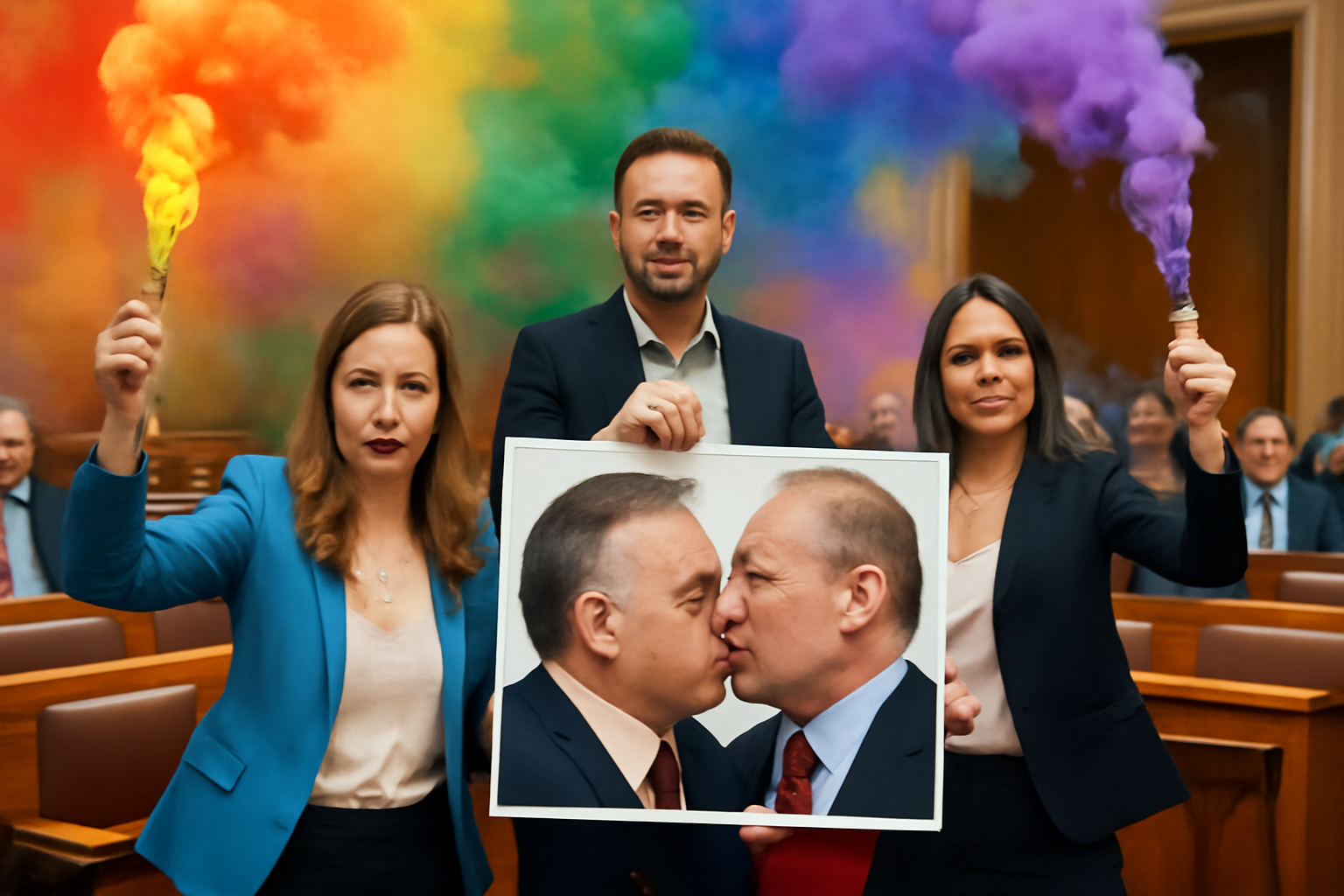
The Hungarian Prime Minister, Viktor Orbán, has sparked outrage by passing a stringent anti-LGBTQ+ law that effectively bans Pride marches across Hungary. The controversial move has led to a dramatic protest in parliament, where members of the centrist Momentum Movement party displayed photos of Orbán kissing Russian President Vladimir Putin and set off colorful smoke bombs in defiance of the new legislation.
The law, introduced by Orbán’s right-wing Fidesz party, was submitted to the Hungarian Parliament on March 18th, just as the 30th anniversary of Budapest Pride approached. It mandates heavy fines for organizers and participants of Pride events, with penalties reaching up to 200,000 forints (approximately £420 or $550). The government claims the ban is a measure to protect children, although critics argue it is a thinly veiled attempt to suppress LGBTQ+ rights and expression.
A particularly concerning aspect of the law is its provision for the use of facial recognition technology to identify and penalize attendees. This has raised significant privacy and human rights concerns, drawing criticism from both domestic and international observers.
Protests and International Reactions
In response to the enactment of this law, Momentum Movement party members executed a bold protest in the Hungarian Parliament. They lit flares and distributed digitally altered images showing Orbán in a compromising position with Putin, a move meant to highlight the perceived alliance between the Hungarian and Russian governments in their anti-LGBTQ+ stances.
The protestors also released multicolored smoke, symbolizing the diversity and resilience of the LGBTQ+ community. "This is not child protection, this is fascism," declared a statement from Budapest Pride, criticizing the law for its discriminatory nature. "The Hungarian government is trying to restrict peaceful protests with a critical voice by targeting a minority. Therefore, as a movement, we will fight for the freedom of all Hungarians to protest!"
Dávid Vig, Director of Amnesty International Hungary, condemned the law as a "full-frontal attack on the LGBTI community and a blatant violation of Hungary’s obligations to prohibit discrimination and guarantee freedom of expression and peaceful assembly." He lamented that this development, just months before Budapest Pride’s milestone anniversary, represents a significant regression in the fight for LGBTQ+ rights in Hungary.
A History of Anti-LGBTQ+ Legislation
The recent law is not an isolated incident in Hungary’s political landscape. In 2021, Orbán’s government passed another controversial law banning the discussion of LGBTQ+ topics in schools and media, a measure reminiscent of Russia’s infamous "anti-propaganda" law. This earlier legislation prompted the European Union to initiate legal action against Hungary and suspend certain funding to the country.
Despite international pressure, Orbán has remained steadfast in his policy. Earlier this year, he reiterated his stance, claiming that no financial incentive could persuade him to accept what he terms "LGBTQ+ propaganda." His government argues that such measures are necessary for child protection, a justification that has been widely criticized as disingenuous and harmful to minority rights.
Gergely Gulyás, Orbán’s chief of staff, further inflamed the situation by suggesting that Pride events should be confined indoors to protect children. This proposal has been met with derision by LGBTQ+ advocates, who see it as an attempt to erase their visibility and suppress their voices.
Looking Forward
As Hungary navigates this contentious period, the international community watches closely. The Momentum Movement and other opposition parties vow to continue resisting these draconian measures, emphasizing the Hungarian spirit of freedom and resistance.
The actions of Viktor Orbán’s government have not only galvanized domestic opposition but have also drawn the ire of human rights organizations worldwide. As Budapest Pride approaches, the world will be watching to see how Hungarians respond to this latest challenge to their rights and freedoms.
Your thoughts are valuable, and we encourage respectful dialogue in the comments below.
Related Posts
Supreme Court to Address State Bans on Trans Women in Female Sports
The upcoming U.S. Supreme Court term promises to be a pivotal moment for transgender rights, as the nation's highest court has agreed to evaluate whether states have the authority to prohibit transgender women from participating in female sports competitions. This case, scheduled to be argued in the next term beginning October, is expected to have a significant impact on the future of sports inclu [...]
Megan Rapinoe and Sue Bird Announce Amicable Separation After Ten Years Together
In a heartfelt announcement that resonated deeply within the sports and LGBTQ+ communities, soccer star Megan Rapinoe and basketball legend Sue Bird have revealed their decision to part ways after nearly a decade together. The couple, who have been icons both on and off the field, shared the news with their fans through a joint statement on social media, expressing that the choice was made with mu [...]
Groundbreaking Ruling Ends Sodomy Ban for Police and Military in the Dominican Republic
The Constitutional Court of the Dominican Republic recently delivered a landmark decision on November 18th, ruling that the nation’s police and armed forces are not permitted to criminalize consensual same-sex relations among their personnel. This pivotal ruling is a significant stride towards equality and the protection of LGBTQ+ rights within these institutions. A Resounding Victory for Equal [...]