
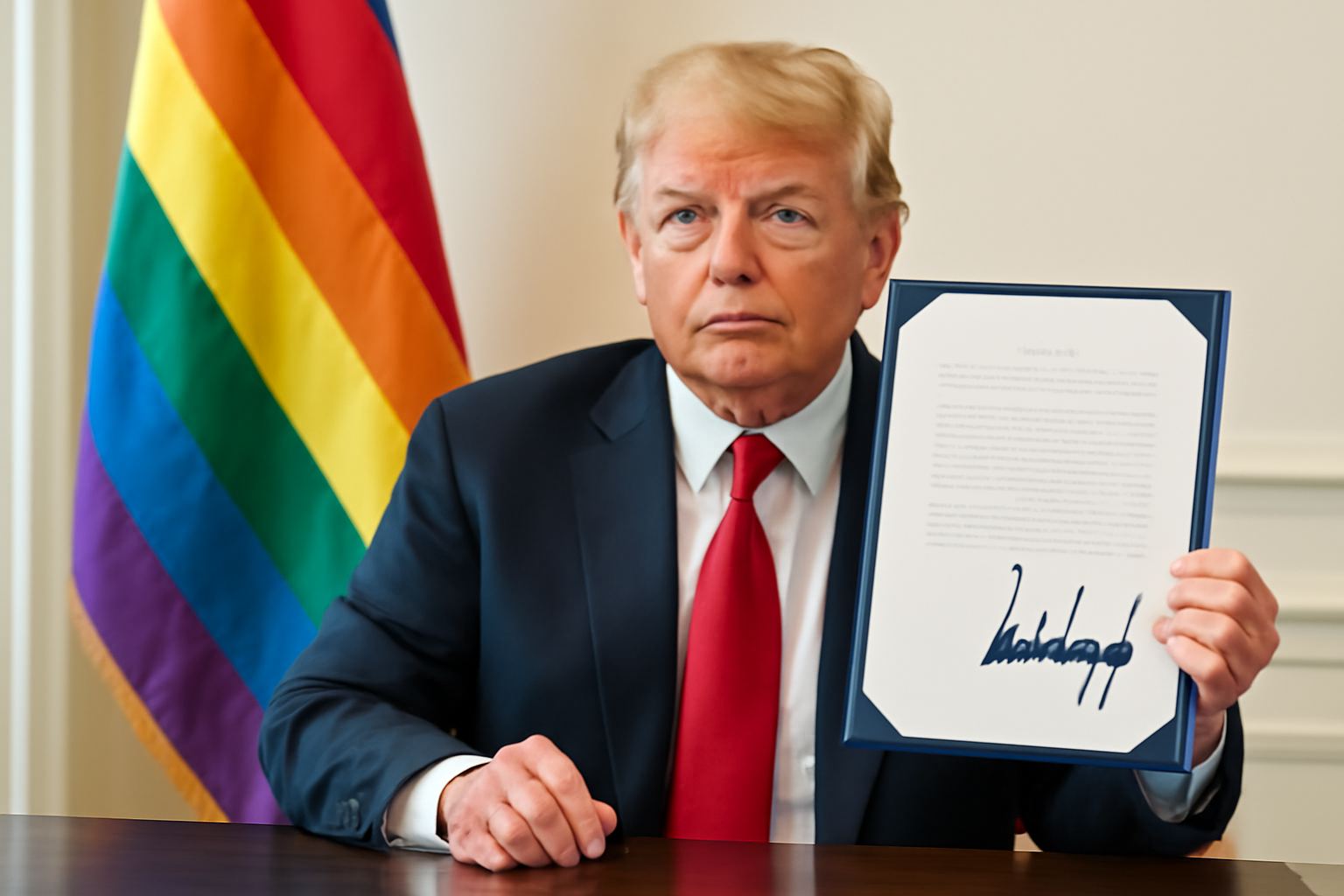
In a significant move that has sent ripples through various communities, President Donald Trump has issued an executive order attempting to redefine the terms "male" and "female" in a manner that has raised significant concerns among scientists, legal experts, and the LGBTQ+ community.
New Definitions and Their Scope
The executive order, entitled "Defending Women From Gender Ideology Extremism and Restoring Biological Truth to the Federal Government," mandates executive agencies across sectors like education, health, housing, and employment to adopt new definitions of "male" and "female":
- "Female" is defined as a person who, at conception, belongs to the sex that produces the large reproductive cell.
- "Male" is defined as a person who, at conception, belongs to the sex that produces the small reproductive cell.
These definitions raise numerous questions regarding their application, especially since the order lacks detailed guidance on implementation across various federal policies, including those related to passports and incarceration.
Impact on Transgender Individuals
The ramifications of this order are particularly severe for transgender individuals, who already face disproportionately high rates of discrimination and violence. The order's approach could validate policies that refuse to acknowledge transgender identities, potentially exposing individuals to increased risks during everyday activities, such as job applications or interactions with law enforcement.
Broader Consequences and Criticism
Critics argue that the executive order's definitions could also support an anti-abortion agenda by framing sex as beginning "at conception," resonating with "fetal personhood" ideologies. This could lead to significant changes in reproductive rights and policies, affecting anyone capable of pregnancy.
Kellan Baker, executive director of a leading LGBTQ health organization, suggests that the order attempts to rigidly define sex based on outdated and narrow biological concepts, ignoring the complexity and variability inherent in human biology.
Scientific Perspectives on Sex and Gender
Scientists assert that sex is not easily defined by a single characteristic such as gamete type or chromosomes. Kathryn Clancy, a biological anthropologist, explains that sex can be contextual and variable, dependent on the particular aspect being studied—whether it's chromosomes, hormones, or reproductive potential. This complexity is often overlooked in simplistic binary classifications.
The executive order's reliance on gamete production as the defining characteristic of sex is criticized for its lack of scientific basis, as gamete production does not occur at conception, nor is it a universally applicable measure of sex.
Historical and Social Context
Historically, gender and sex have been viewed through various lenses, influenced by cultural and social constructs. The executive order is seen by some as an attempt to impose an overly simplistic and scientifically unsubstantiated view of sex and gender, which fails to account for intersex individuals or the diversity of human experiences and bodies.
Moreover, this approach aligns with troubling historical narratives that seek to rigidly define gender roles, often linked to racial and cultural hierarchies.
Uncertain Future
With agencies expected to report on their progress in implementing these definitions within months, the future remains uncertain. Legal challenges are anticipated as the implications of this order continue to unfold. Experts remain concerned about the potential for increased discrimination and the undermining of scientific and ethical standards in policy-making.
The ongoing debate highlights the need for informed, inclusive, and scientifically grounded discussions about gender and sex, recognizing the rich diversity of human identity and experience.
Subscribe to our newsletter for more insights into how political decisions impact LGBTQ+ communities worldwide.
Related Posts
Supreme Court to Address State Bans on Trans Women in Female Sports
The upcoming U.S. Supreme Court term promises to be a pivotal moment for transgender rights, as the nation's highest court has agreed to evaluate whether states have the authority to prohibit transgender women from participating in female sports competitions. This case, scheduled to be argued in the next term beginning October, is expected to have a significant impact on the future of sports inclu [...]
Megan Rapinoe and Sue Bird Announce Amicable Separation After Ten Years Together
In a heartfelt announcement that resonated deeply within the sports and LGBTQ+ communities, soccer star Megan Rapinoe and basketball legend Sue Bird have revealed their decision to part ways after nearly a decade together. The couple, who have been icons both on and off the field, shared the news with their fans through a joint statement on social media, expressing that the choice was made with mu [...]
Groundbreaking Ruling Ends Sodomy Ban for Police and Military in the Dominican Republic
The Constitutional Court of the Dominican Republic recently delivered a landmark decision on November 18th, ruling that the nation’s police and armed forces are not permitted to criminalize consensual same-sex relations among their personnel. This pivotal ruling is a significant stride towards equality and the protection of LGBTQ+ rights within these institutions. A Resounding Victory for Equal [...]