
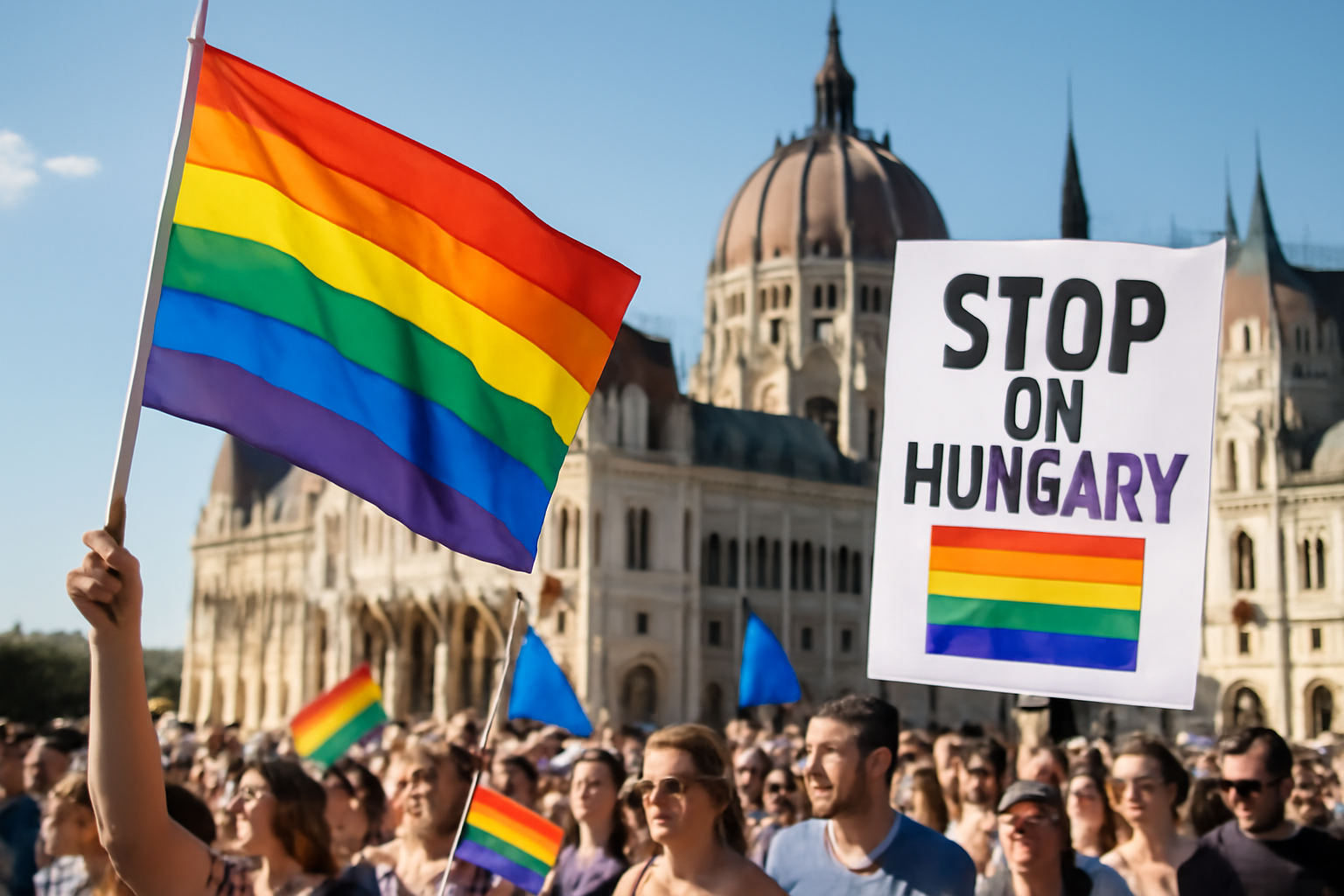
Across Europe, a significant number of countries, including France and Germany, are advocating for decisive action from the European Commission (E.C.) against Hungary's recent legislation banning Pride events. This call to action comes in the form of a strongly-worded letter addressed to the E.C. by numerous European Union member states, urging the use of legal mechanisms to challenge Hungary's restrictive laws.
Legal and Political Backdrop
The controversy stems from Hungary's introduction of the Assembly Act, a law that prohibits events featuring any "depiction or promotion" of homosexuality if minors are potentially present. The law imposes fines and authorizes the use of facial recognition technology to monitor attendees at such events. This legislation was expedited through Hungary’s Parliament, sparking widespread condemnation.
Notably, this new law expands upon Hungary’s 2021 legislation that restricts the portrayal of LGBTQ+ topics to those under 18, affecting educational content and media representations.
The law has been met with protests from Hungary's LGBTQ+ community, and the European Union has criticized Hungary for infringing upon the rights of its citizens to peacefully assemble.
International Response and Potential Actions
The coalition of countries advocating against Hungary's legislation includes Austria, Belgium, Czechia, Denmark, Estonia, France, Finland, Germany, Ireland, Latvia, Lithuania, Luxembourg, the Netherlands, Portugal, Slovenia, and Sweden. These nations are pushing for the E.C. to take concrete steps, although the letter does not specify exact measures.
One proposed action is an "interim measure" akin to an injunction to halt the enforcement of the ban—an urgent need as Budapest's Pride events approach.
The E.C. has already withheld €18 billion in funding due to Hungary’s violations related to rule-of-law principles, reflecting broader discontent with Prime Minister Viktor Orban’s consolidation of power and measures against civil organizations.
Despite these efforts, there are challenges. Commissioner for Humanitarian Aid and Crisis Management Hadja Lahbib expressed doubts about the feasibility of pursuing an interim measure, citing insufficient support within the E.C.
The Broader Implications for EU-Hungary Relations
Further complicating the situation, the E.U. is contemplating the "nuclear option" of suspending Hungary's voting rights in the European Council. This drastic measure would require the agreement of four-fifths of E.U. countries and unanimous consent from all member states except Hungary.
This potential action is not only a response to the Pride ban but also to Hungary's pattern of opposition to E.U. policies, such as resisting aid to Ukraine.
European Commissioner Michael McGrath highlighted the importance of the rule of law, stating that adherence to these principles is non-negotiable for E.U. membership, emphasizing that the current situation in Hungary “is just not acceptable.”
Conclusion and Forward Actions
The unfolding scenario presents a complex challenge for the European Union, balancing the enforcement of its core values with diplomatic relations among its members. The effectiveness of any actions taken by the E.C. will be closely monitored, especially by Pride organizers who are resolute in their plans to celebrate on June 28.
The situation in Hungary remains under intense scrutiny, as the international community awaits the European Commission's next steps, mindful of the broader implications for LGBTQ+ rights and European unity. As these developments progress, the global LGBTQ+ community remains vigilant, advocating for equality and the fundamental freedoms of expression and assembly.
For more insights, subscribe to our newsletter and stay updated on political developments affecting the LGBTQ+ community.
Related Posts
Supreme Court to Address State Bans on Trans Women in Female Sports
The upcoming U.S. Supreme Court term promises to be a pivotal moment for transgender rights, as the nation's highest court has agreed to evaluate whether states have the authority to prohibit transgender women from participating in female sports competitions. This case, scheduled to be argued in the next term beginning October, is expected to have a significant impact on the future of sports inclu [...]
Megan Rapinoe and Sue Bird Announce Amicable Separation After Ten Years Together
In a heartfelt announcement that resonated deeply within the sports and LGBTQ+ communities, soccer star Megan Rapinoe and basketball legend Sue Bird have revealed their decision to part ways after nearly a decade together. The couple, who have been icons both on and off the field, shared the news with their fans through a joint statement on social media, expressing that the choice was made with mu [...]
Groundbreaking Ruling Ends Sodomy Ban for Police and Military in the Dominican Republic
The Constitutional Court of the Dominican Republic recently delivered a landmark decision on November 18th, ruling that the nation’s police and armed forces are not permitted to criminalize consensual same-sex relations among their personnel. This pivotal ruling is a significant stride towards equality and the protection of LGBTQ+ rights within these institutions. A Resounding Victory for Equal [...]