
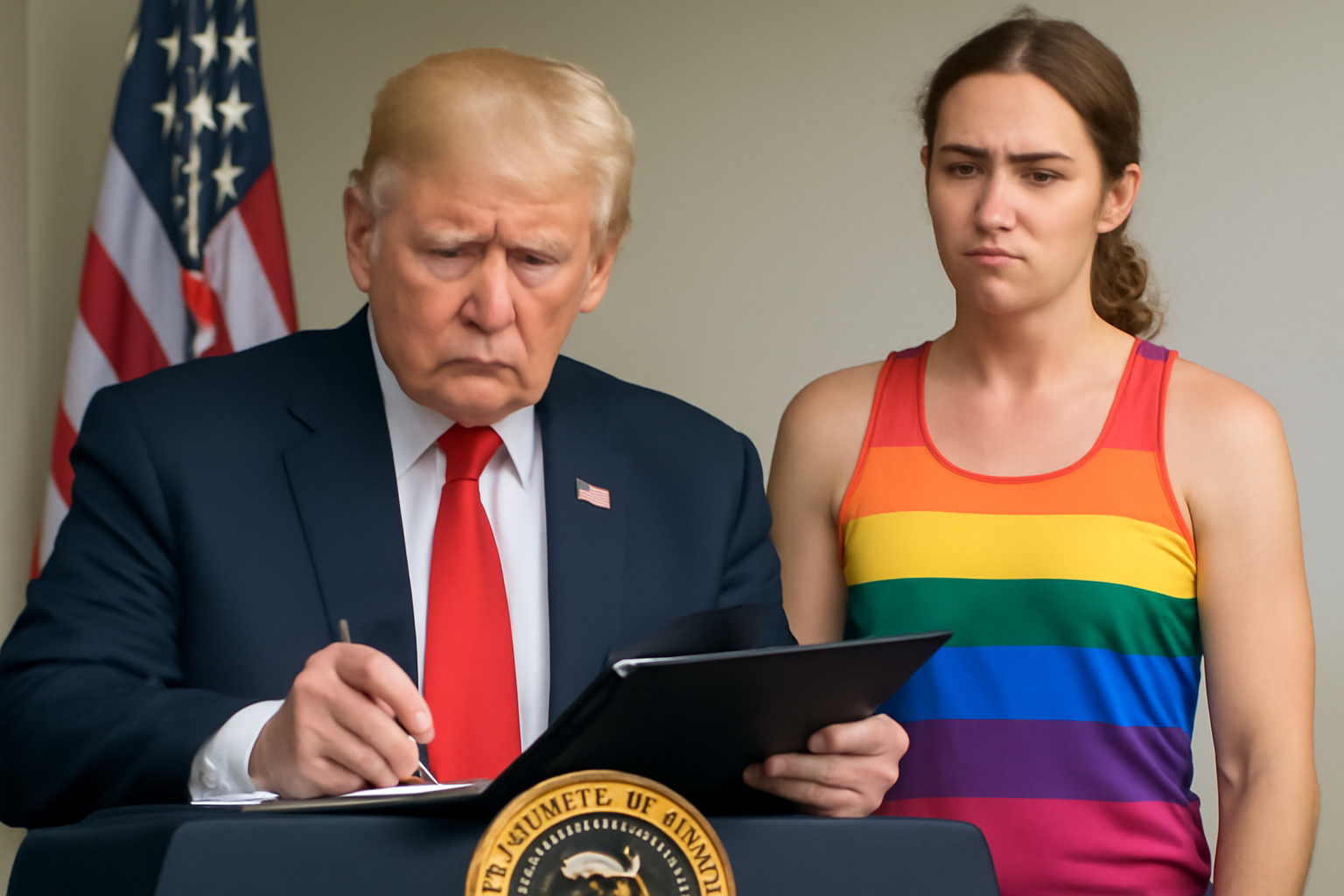
President Donald Trump has recently signed a controversial executive order aimed at restricting the participation of transgender girls and women in female sports. This move has sparked widespread debate and concern within the LGBTQ+ community and beyond.
The executive order seeks to withhold federal funding from educational institutions that permit transgender female athletes to compete on girls’ and women’s sports teams. Additionally, it directs the Department of Justice to take legal action against schools that allow for the inclusion of trans athletes in female sports.
Beyond these immediate measures, the order also aims to gather representatives from major athletic organizations and sports governing bodies to establish guidelines that exclude trans athletes from certain competitions. The order threatens to prevent cisgender athletes from participating in international events that allow transgender competitors.
Impact on Schools and Sports Organizations
This executive order reflects a significant departure from past interpretations of Title IX, a 1972 law that prohibits sex-based discrimination in educational programs. Under the previous administration of President Joe Biden, Title IX was interpreted to include protections for transgender students, ensuring their right to participate in sports based on their gender identity.
While the Biden administration had proposed a rule change to offer guidance on the participation of transgender athletes, it ultimately rescinded the proposal, citing the complexity and contentious nature of the issue. In contrast, the current order seeks to immediately impose restrictions and penalties on schools permitting trans inclusion in sports.
The order explicitly opposes policies from sports organizations that allow trans women to compete, even when they meet stipulated criteria such as reduced testosterone levels or gender identity documentation. These policies, according to the order, fail to protect the integrity and safety of women’s sports.
Reactions from the LGBTQ+ Community
The executive order has been met with significant backlash from LGBTQ+ advocacy groups and civil rights organizations. Critics argue that it unfairly targets transgender individuals and perpetuates harmful stereotypes and discrimination.
Human Rights Campaign president Kelley Robinson condemned the order, stating, “While we all desire fair sports and safe environments for students, a blanket ban undermines those goals. This measure could lead to increased harassment and discrimination, particularly against young people who do not conform to traditional gender norms.”
GLAAD, a prominent LGBTQ+ watchdog group, also released a statement denouncing the order as an inaccurate and divisive policy that does not change existing laws or facts. The organization emphasized the importance of inclusivity, stating that transgender women and girls deserve the same opportunities to participate in sports, make personal decisions, and live without fear of institutional bias.
Broader Implications and Current Landscape
The order arrives amid a broader wave of legislative efforts at the state level to restrict transgender athletes. Currently, 27 states have enacted policies that ban trans athletes from participating in girls’ and women’s sports, affecting not only K-12 education but also university-level and co-ed recreational sports.
These state-level laws have resulted in the targeting and scrutiny of cisgender girls and women, often labeled as "trans-vestigated" whenever there is suspicion about their gender identity. Such policies have raised concerns about privacy and the fairness of subjecting athletes to invasive gender checks.
As the debate continues, advocacy groups remain committed to protecting the rights of transgender individuals and ensuring that sports remain a space where all youth can learn the values of teamwork, dedication, and inclusion. The issue underscores the ongoing struggle for recognition and equality within the sports community and society at large.
To stay informed on developments affecting the LGBTQ+ community, consider subscribing to our newsletter, which provides insights into political changes, legal challenges, and ongoing advocacy efforts.
Tags: Transgender Rights, Sports Policy, LGBTQ+ Advocacy, Title IX, Civil Rights
Related Posts
Supreme Court to Address State Bans on Trans Women in Female Sports
The upcoming U.S. Supreme Court term promises to be a pivotal moment for transgender rights, as the nation's highest court has agreed to evaluate whether states have the authority to prohibit transgender women from participating in female sports competitions. This case, scheduled to be argued in the next term beginning October, is expected to have a significant impact on the future of sports inclu [...]
Megan Rapinoe and Sue Bird Announce Amicable Separation After Ten Years Together
In a heartfelt announcement that resonated deeply within the sports and LGBTQ+ communities, soccer star Megan Rapinoe and basketball legend Sue Bird have revealed their decision to part ways after nearly a decade together. The couple, who have been icons both on and off the field, shared the news with their fans through a joint statement on social media, expressing that the choice was made with mu [...]
Groundbreaking Ruling Ends Sodomy Ban for Police and Military in the Dominican Republic
The Constitutional Court of the Dominican Republic recently delivered a landmark decision on November 18th, ruling that the nation’s police and armed forces are not permitted to criminalize consensual same-sex relations among their personnel. This pivotal ruling is a significant stride towards equality and the protection of LGBTQ+ rights within these institutions. A Resounding Victory for Equal [...]