
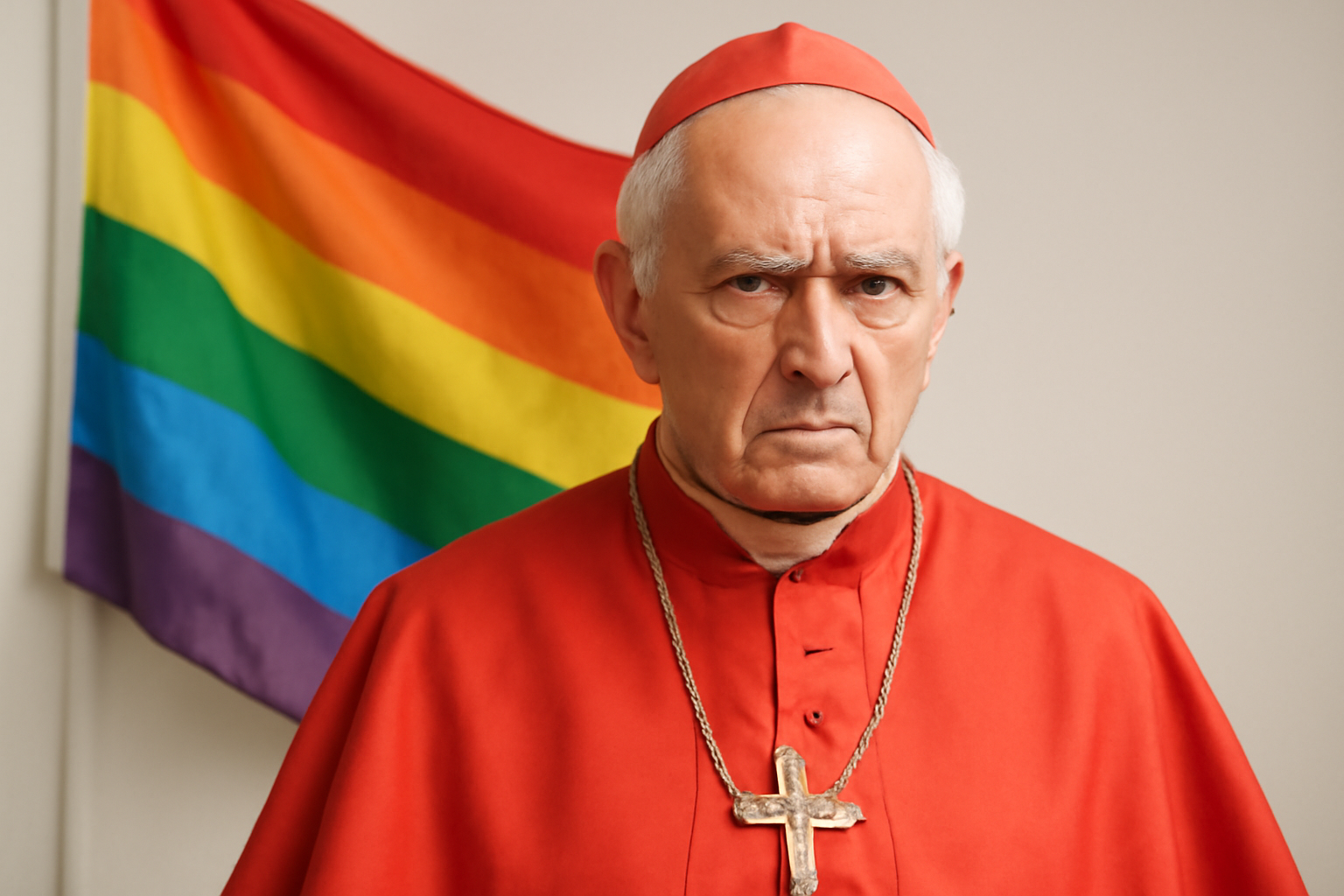
Cardinal Calls for Firm Stance on LGBTQ+ Issues in New Papal Election
As the Roman Catholic Church prepares to select its new leader, the topic of LGBTQ+ rights and representation within the Church has taken center stage. A prominent conservative cardinal has recently voiced his opinion that the incoming pope should address what he describes as the "gay lobby" with a firm hand.
The conclave, a gathering of cardinals responsible for electing the new pope, will commence its deliberations on May 7. This follows the recent passing of Pope Francis at the age of 88. Pope Francis, who rose to the papacy in 2013 after the resignation of Pope Benedict XVI, was known for his nuanced and at times contradictory approach to LGBTQ+ rights. Despite his complex stance, he was acknowledged by many queer Catholics for initiating important dialogues around these issues within the Church.
Speaking to an Italian publication, Cardinal Gerhard Ludwig Müller, a German prelate who has been openly critical of Pope Francis, insisted that the next pope must be "strong on doctrine" and resolute in opposing "ideological lobbies," including those advocating for LGBTQ+ causes. Müller emphasized the necessity of a new pope with "a solid theological and doctrinal formation," advocating for a return to "orthodoxy, doctrine founded on scripture and apostolic tradition, and against heresy."
He elaborated further, stating: "Doctrine is not the property of the pope, the bishops, or the faithful; it must conform to the word of Jesus. No one can modify it. If Jesus says marriage is between a man and a woman, no one can change this doctrine."
He also expressed his concerns about the "homosexual lobby" attempting to equate marriage with same-sex unions, which he believes "totally contradicts the doctrine of the Bible." Additionally, Müller criticized what he referred to as "gender ideology," viewing it as contrary to Church teachings.
These views starkly contrast with those of many LGBTQ+ Catholics who have hoped for a more inclusive and understanding Church leadership. Following the death of Pope Francis, Marianne Duddy-Burke, who co-chairs the Global Network of Rainbow Catholics, expressed her wish for the cardinals to select a successor who is "attuned to the signs of the current times" and who, like Pope Francis, could be a "true shepherd, walking with all the sheep wherever they may be."
Christopher Vella, her co-chair, echoed these sentiments, highlighting that for Pope Francis, the LGBTQ+ community was viewed "first and foremost as children of God, not as a theological problem or moral conundrum." He acknowledged that while Francis may not have fully understood issues particularly affecting gender-non-binary and transgender individuals, his intentions were sincere and compassionate.
The Process of Selecting a New Pope
While technically any baptized Roman Catholic man could be elected to the papacy, tradition has long dictated that the new pope is chosen from among the College of Cardinals. These cardinals, all under the age of 80, will convene in Rome for the secretive voting process.
During the conclave, cardinals gather in the Sistine Chapel, each casting their vote by writing the name of their chosen candidate on a paper ballot, which is then placed into a chalice. This process ensures anonymity. Voting is conducted in rounds, with up to four rounds taking place each day until one candidate secures a two-thirds majority.
The world remains unaware of the proceedings until a decision is reached, signaled by white smoke rising from the Vatican’s chimney. As the Church prepares to elect a new religious leader for its 1.4 billion followers worldwide, speculation abounds regarding potential candidates. Among those considered are Italian Pietro Parolin, Luis Antonio Tagle from the Philippines, and Ghanaian Peter Turkson.
As the Church stands at a crossroads, the upcoming election holds significant implications for its direction on LGBTQ+ issues. The conversation continues as members of the Church and its global community await the outcome. Share your thoughts in the comments below, and let’s keep the dialogue respectful and open.
Related Posts
Supreme Court to Address State Bans on Trans Women in Female Sports
The upcoming U.S. Supreme Court term promises to be a pivotal moment for transgender rights, as the nation's highest court has agreed to evaluate whether states have the authority to prohibit transgender women from participating in female sports competitions. This case, scheduled to be argued in the next term beginning October, is expected to have a significant impact on the future of sports inclu [...]
Megan Rapinoe and Sue Bird Announce Amicable Separation After Ten Years Together
In a heartfelt announcement that resonated deeply within the sports and LGBTQ+ communities, soccer star Megan Rapinoe and basketball legend Sue Bird have revealed their decision to part ways after nearly a decade together. The couple, who have been icons both on and off the field, shared the news with their fans through a joint statement on social media, expressing that the choice was made with mu [...]
Groundbreaking Ruling Ends Sodomy Ban for Police and Military in the Dominican Republic
The Constitutional Court of the Dominican Republic recently delivered a landmark decision on November 18th, ruling that the nation’s police and armed forces are not permitted to criminalize consensual same-sex relations among their personnel. This pivotal ruling is a significant stride towards equality and the protection of LGBTQ+ rights within these institutions. A Resounding Victory for Equal [...]